Service Delivery
Connect intake, knowledge, ownership and technical recovery.
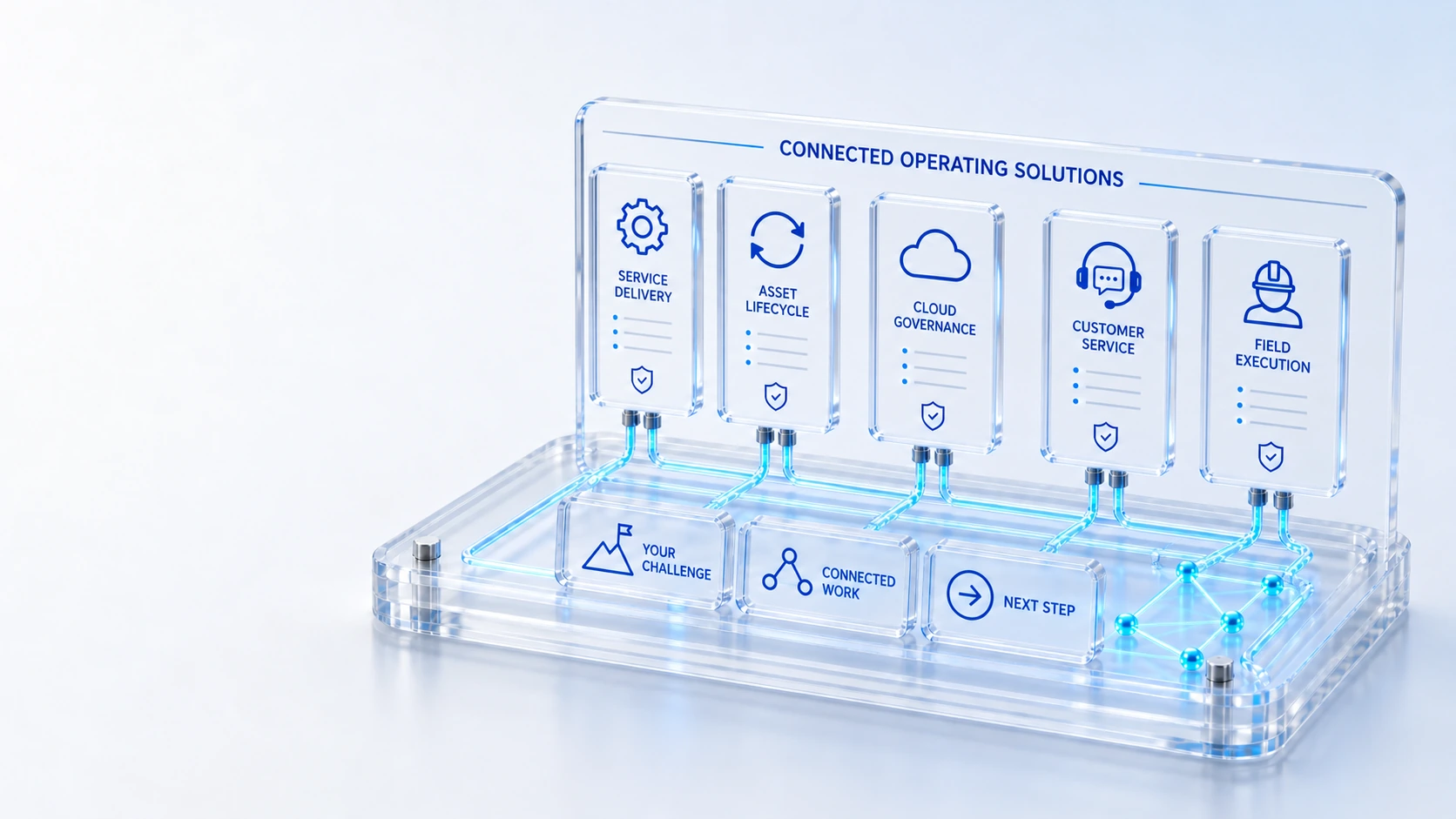
Service DeliveryConnect intake, knowledge, ownership and technical recovery.
Estate IntelligenceBring CMDB, discovery, hardware and software into context.
Connected ResponsibilitiesKeep customer, supplier and field work connected.
A Practical Starting PointEvaluate one workflow, source data and acceptance criteria.
ChallengeCapability
Find a path from your operating challenge to the capabilities and workspaces that address it.
Connect intake, knowledge, ownership and technical recovery.
Bring CMDB, discovery, hardware and software into context.
Keep customer, supplier and field work connected.
Evaluate one workflow, source data and acceptance criteria.
Challenge → Capability → Next step
Explore the details below, then bring your workflow, source data and questions to a guided conversation.
Connect portal intake, knowledge and contextual assistance with accountable human service workflows.
Explore 02 / CONNECTED PLATFORMCoordinate changes, CAB schedules, blackout windows, standard templates and recorded dependency context.
Explore 03 / CONNECTED PLATFORMConnect verified provider costs, independently reviewed budgets and qualified baseline forecasts.
Explore 04 / CONNECTED PLATFORMConfigure discovery, verify read-only connections and validate infrastructure plans with explicit evidence.
Explore 05 / CONNECTED PLATFORMConnect record permissions, activity, evidence and configured approval steps. Validate regulatory requirements during discovery.
Explore 06 / CONNECTED PLATFORMUnite service workflows, assets and cloud context with a shared operational foundation.
Explore 07 / CONNECTED PLATFORMConnect internal service operations, customer cases and qualified field execution.
Explore 08 / CONNECTED PLATFORMBring priority, ownership, affected CIs, operational events and service recovery into incident work.
Explore 09 / CONNECTED PLATFORMUnite configuration records, physical locations, discovery and governed operations.
Explore 10 / CONNECTED PLATFORMBring incident, problem, change, request, knowledge and service level workflows into one platform.
Explore 11 / CONNECTED PLATFORMBring account-aware cases, contracts, qualified vendor work and service evidence together.
Explore 12 / CONNECTED PLATFORMConnect problem records, incident history, known errors and operational knowledge.
Explore 13 / CONNECTED PLATFORMConnect catalog intake, service requests, approval and asset fulfillment context.
Explore 14 / CONNECTED PLATFORMAssess your data and integrations, map the service model, and validate a focused operational journey before expanding.
Explore 15 / CONNECTED PLATFORMUnite case ownership, entitlement, incident recovery and field execution in one connected service journey.
Explore 16 / CONNECTED PLATFORMConnect location coverage, qualifications, work plans and completion evidence before and after dispatch.
Explore 17 / CONNECTED PLATFORMConnect employee demand, custody, stockroom supply, lifecycle exposure and offboarding recovery.
Explore 18 / CONNECTED PLATFORMBring product, installation, entitlement, renewal and reclamation context into software decisions.
Explore 19 / CONNECTED PLATFORMConnect power, cooling, network, compute and customer equipment to governed on-site work.
Explore 20 / CONNECTED PLATFORMConnect discovery, identification, reconciliation, normalization and certification to canonical configuration records.
Explore 21 / CONNECTED PLATFORMSeparate recorded outage intervals, customer status, maintenance and response commitments while connecting their work.
ExploreA connected service journey
Keep customer context, technical recovery and qualified field work connected without collapsing their responsibilities.
Capture the account, affected asset and configured coverage.
Link incidents and recorded outages to the affected CI.
Coordinate approved work plans, coverage and execution evidence.
Return completed work for support review and customer follow-up.
Who this is for
A solution starts with a business problem and the teams responsible for it. Several products may contribute, but the useful question is how records, decisions and evidence connect into a workable journey. Select a scenario whose boundaries and source data can be inspected.
Illustrative walkthrough
An organization wants to improve a handoff between customer support, internal technical response and on-site delivery. The solution should identify the product workspaces involved while preserving the accountability of each team.
Identify the trigger, affected person or service, and the owner of the first decision. Select a relevant solution page rather than beginning with every feature in the platform. Use an example specific enough for the participating teams to recognize.
Follow the solution’s product links to understand the records and workflows involved. Identify the integration, configuration, access and data prerequisites for each handoff. A solution description is an evaluation path, not a promise that an unconfigured environment already implements your process.
Walk through the scenario with the relevant roles and inspect the supporting evidence. Define an acceptable result and the measures that would help evaluate it. Use the findings to shape implementation scope, commercial discussion and any later expansion.
For this illustrative evaluation, retain the starting records, the decisions made by each accountable role, and the evidence that supports completion. Agree the scope and acceptance criteria before interpreting a demonstration as production readiness.
Explore the platform
Open a workspace for a closer look.
Prepare the evaluation
These are evaluation criteria, not promised outcomes. Agree the baseline, scope, source coverage and acceptance method with the responsible owners before drawing conclusions.
Questions for this topic
Solutions organize an operating journey around a problem. Product pages explain the contributing capabilities in more detail. Use both to distinguish the desired outcome from the modules, records and implementation work needed to support it.
Organizations have different roles, data and approval requirements. The examples explain patterns that can be evaluated. Your proposed configuration, integrations and acceptance criteria should be reviewed and agreed for the scope you need.
It can, but keep the starting scope understandable. Identify the overlapping records and teams, then decide which handoffs must be demonstrated first. A focused scenario usually makes assumptions and dependencies easier to inspect.
Your next operating chapter
Bring one workflow, one service challenge or one part of your estate. We’ll show you where Qintorava fits.