Configuration Inventory
Maintain canonical equipment records.
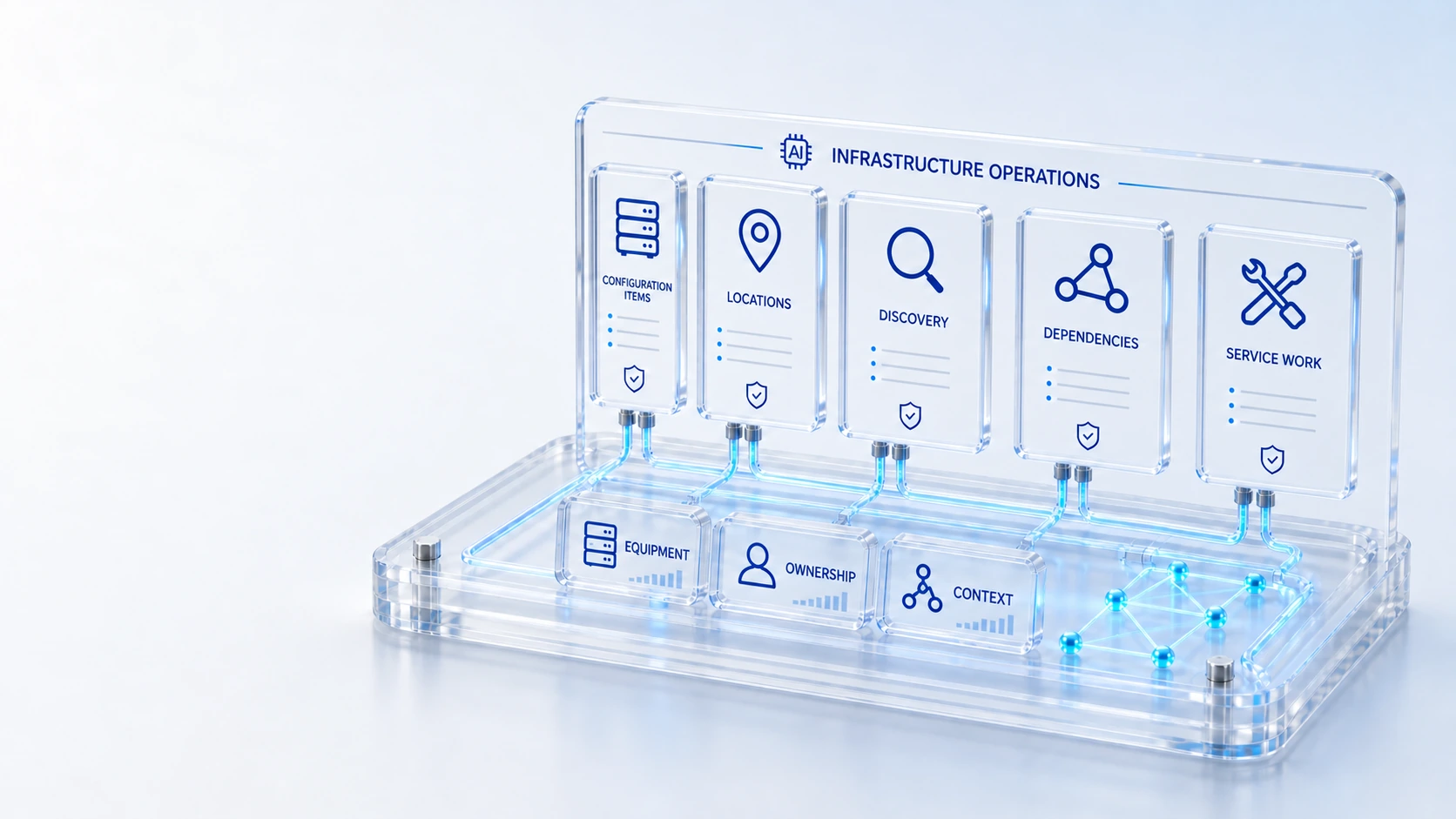
Configuration InventoryMaintain canonical equipment records.
Physical LocationsRelate assets to facilities and rack hierarchy.
Discovery ContextConnect source scope and reconciled inventory.
Operational WorkBring ownership and services into investigation.
InventoryContext
Unite configuration records, physical locations, discovery and governed operations.
Maintain canonical equipment records.
Relate assets to facilities and rack hierarchy.
Connect source scope and reconciled inventory.
Bring ownership and services into investigation.
Inventory → Context → Operations
Explore the details below, then bring your workflow, source data and questions to a guided conversation.
Built into the platform
Maintain typed classes and canonical configuration records.
Traverse recorded relationships and location ancestry.
Relate campus, site, building, floor, room and rack.
Distinguish compute, network, power, cooling and shared equipment.
Maintain provider and infrastructure discovery configuration.
Define discovery behavior for supported sources.
Actual product view
See the running demo environment. Features and records are subject to your role, configuration and integrations.
Connected capabilities
Connect typed CIs, dependencies, service portfolios, services and offerings to hardware, software and customer operations.
Explore 02 / infrastructureConnect facilities, customer equipment, IT/OT CIs, capacity, qualified work and service impact in a datacenter operating workspace.
Explore 03 / infrastructureConfigure discovery sources, patterns, ranges and schedules, then reconcile confirmed inventory into the shared CMDB.
ExploreImplementation context
Features depend on enabled modules, configured roles, source data and supported integrations. Agree your implementation scope and acceptance criteria during discovery.
Who this is for
Infrastructure records are harder to use when equipment identity, location and service relationships are maintained independently. Teams need a connected view of the recorded estate and its operating role, with enough source and ownership context to plan investigation or service work responsibly.
Illustrative walkthrough
In this illustrative scenario, an infrastructure team investigates equipment that supports a shared service. It reviews discovery and canonical configuration context, locates the item in the recorded physical hierarchy and follows service dependencies before coordinating the appropriate operational owner and next work.
Identify the canonical configuration item and review the discovery context contributing to it. Inspect identification, reconciliation and lineage where available. Confirm whether the evidence covers the relevant equipment before using the inventory as the basis for a wider claim about the organization’s complete infrastructure estate.
Inspect the recorded location, physical hierarchy and IT or OT classification alongside service and dependency relationships. Work with the responsible owners to validate unclear associations. A useful relationship view should make the equipment’s operating role easier to discuss without substituting for physical checks or current engineering knowledge.
Bring the validated context into the relevant incident, change or qualified field workflow. Preserve access boundaries and each team’s responsibilities as work progresses. Review the supporting records and evidence afterwards so service decisions can be understood without reconstructing the same disconnected equipment and ownership story.
Inspect canonical identity, discovery lineage, physical context and recorded service relationships together. These support infrastructure understanding and work coordination; they do not establish universal discovery coverage, real-time physical condition or permission to operate every item in the estate.
Explore the platform
Open a workspace for a closer look.
Prepare the evaluation
These are evaluation criteria, not promised outcomes. Agree the baseline, scope, source coverage and acceptance method with the responsible owners before drawing conclusions.
Questions for this topic
The reviewed scope connects discovery, configuration, physical context and governed operational work. It does not establish unrestricted device control or replace specialized industrial and facilities systems. Confirm the supported integrations, permissions and intended actions for your environment before defining an implementation boundary.
Location and service relationships answer different operational questions. Bringing them together can help teams identify where equipment sits and which recorded services depend on it. Evaluate data completeness and ownership for both models rather than assume that an accurate location automatically establishes accurate service impact.
Choose equipment with meaningful service and physical relationships, then inspect discovery lineage, canonical identity, ownership and a related work process. Include a data-quality exception so evaluators can see how uncertainty is handled instead of judging the platform only on a carefully complete demonstration record.
Your next operating chapter
Bring one workflow, one service challenge or one part of your estate. We’ll show you where Qintorava fits.