Discovery Sources
Maintain provider and infrastructure discovery configuration.
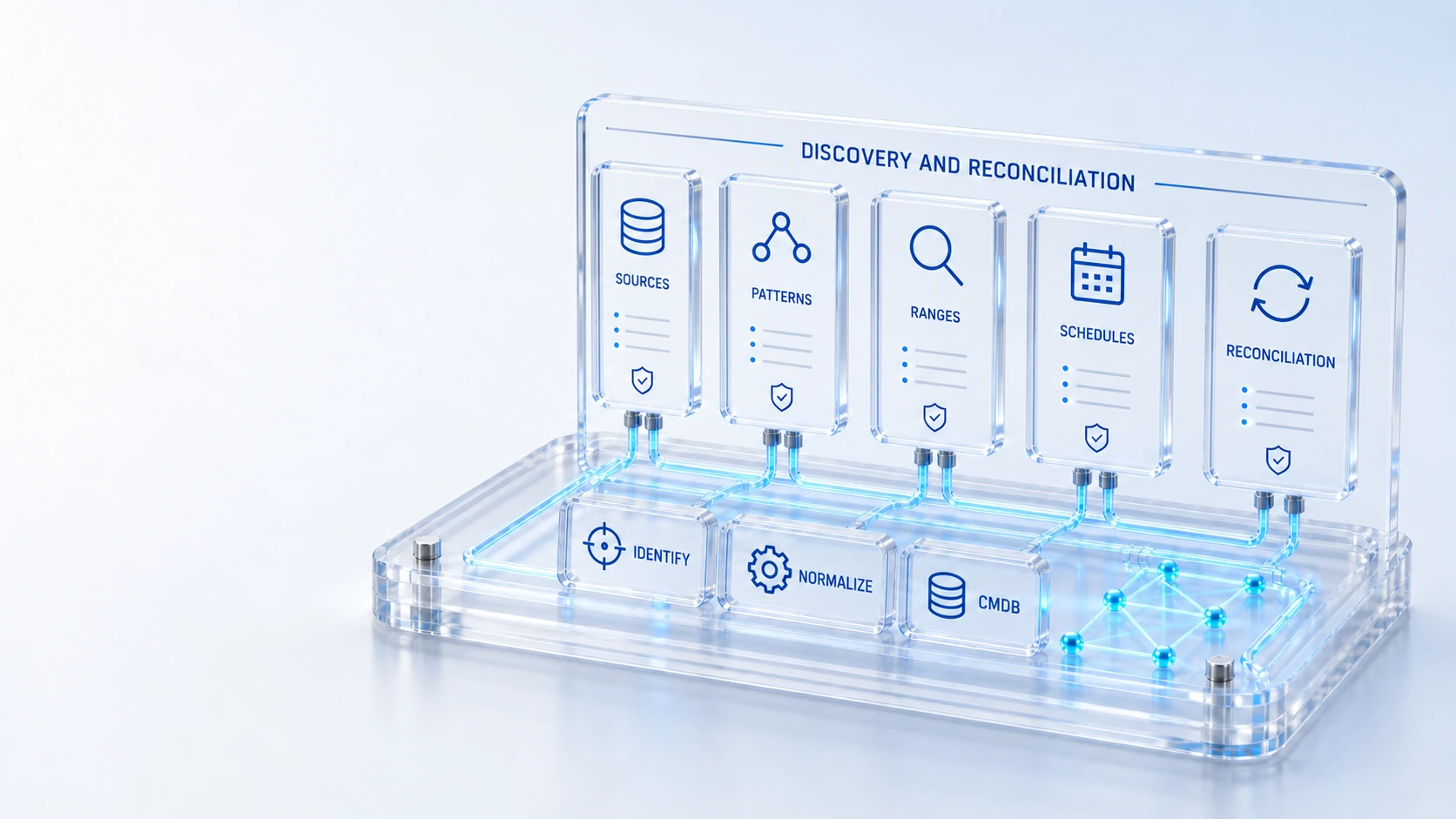
Discovery SourcesMaintain provider and infrastructure discovery configuration.
PatternsDefine discovery behavior for supported sources.
RangesControl the discovery scope.
SchedulesCoordinate when configured discovery runs.
ScopeDiscover
Configure discovery sources, patterns, ranges and schedules, then reconcile confirmed inventory into the shared CMDB.
Maintain provider and infrastructure discovery configuration.
Define discovery behavior for supported sources.
Control the discovery scope.
Coordinate when configured discovery runs.
Scope → Discover → Reconcile
Explore the details below, then bring your workflow, source data and questions to a guided conversation.
Built into the platform
Maintain provider and infrastructure discovery configuration.
Define discovery behavior for supported sources.
Control the discovery scope.
Coordinate when configured discovery runs.
Apply IRE rules to discovered data.
Retain provider identity and recorded relationships.
Actual product view
See the running demo environment. Features and records are subject to your role, configuration and integrations.
Connected by design
Service records, configuration items, people, locations and evidence share the same operational foundation. Move from investigation to the related asset, service or customer workflow with clear ownership.
Explore the platform architectureImplementation context
Views and actions follow configured roles, permissions, enabled modules and connected source data. Screens show a demonstration environment.
Who this is for
Inventory ingestion creates more confusion when sources overlap, identifiers drift or discovery scope is uncontrolled. A reliable foundation requires explicit sources, supported behavior and reconciliation evidence before discovered resources become shared operational records. An evaluation of Discovery & Reconciliation should make those boundaries inspectable before the team relies on the operating view.
Illustrative walkthrough
A fictional infrastructure team introduces a new discovery source alongside an existing cloud scope. The administrator needs a controlled range and schedule, then wants to inspect how confirmed resources are identified and reconciled. This is an illustrative evaluation scenario, not a claim about a customer deployment.
Review the supported discovery source and pattern, identify the authorized scope and confirm which resources the proposed range is intended to cover. Maintain provider and infrastructure discovery configuration.
Choose the configured schedule and responsible owner, then inspect recorded results rather than assuming that a saved schedule proves inventory was obtained. Control the discovery scope. Ask the demonstrator to identify the responsible role and the source evidence for this step.
Apply identification and reconciliation rules to confirmed discovered data and retain provider identity and relationship lineage when reviewing the resulting CMDB records. Apply IRE rules to discovered data.
Follow one confirmed discovered resource from its source configuration through identification and reconciliation to the canonical CI; compare it with a resource that has not yet been confirmed. Use demonstration records and preserve the applicable reporting scope.
Explore the platform
Open a workspace for a closer look.
Prepare the evaluation
These are evaluation criteria, not promised outcomes. Agree the baseline, scope, source coverage and acceptance method with the responsible owners before drawing conclusions.
Questions for this topic
No. A schedule controls when configured discovery is intended to run; source access, supported patterns, results and confirmation must still be reviewed before claiming coverage.
Identification and reconciliation rules support matching discovered data to the shared inventory, and administrators should inspect their configured identifiers and outcomes for the selected source.
Cloud management can reuse configured discovery sources and authorized credential aliases, but provider permissions and successful connection verification remain distinct prerequisites.
Your next operating chapter
Bring one workflow, one service challenge or one part of your estate. We’ll show you where Qintorava fits.