Cloud Estate
Track configured provider scopes and connection verification separately.
Cloud EstateTrack configured provider scopes and connection verification separately.
Intent and PlansCreate and locally validate structured infrastructure plans.
Provider ValidationDistinguish local policy validation from provider-validated plans.
Shared DiscoveryReuse discovery sources and authorized credential aliases.
ConfigureVerify
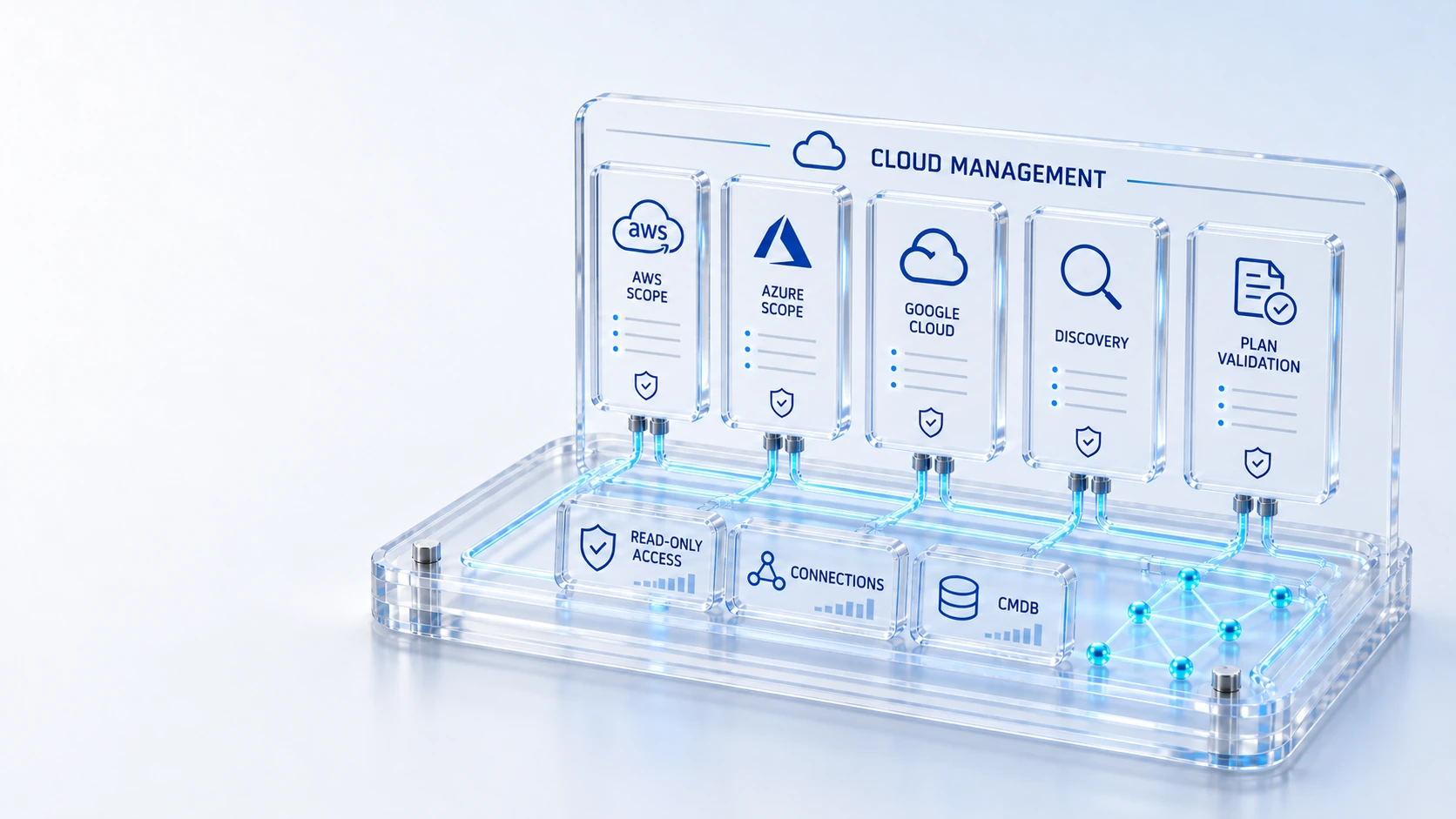
Configure AWS, Azure and Google Cloud scopes, verify read-only connections, discover resources and validate infrastructure intent.
Track configured provider scopes and connection verification separately.
Create and locally validate structured infrastructure plans.
Distinguish local policy validation from provider-validated plans.
Reuse discovery sources and authorized credential aliases.
Configure → Verify → Validate
Explore the details below, then bring your workflow, source data and questions to a guided conversation.
Built into the platform
Track configured provider scopes and connection verification separately.
Create and locally validate structured infrastructure plans.
Distinguish local policy validation from provider-validated plans.
Reuse discovery sources and authorized credential aliases.
Reconcile confirmed discovered resources into the shared inventory.
Review validation outcomes and recorded operations.
Actual product view
See the running demo environment. Features and records are subject to your role, configuration and integrations.
Connected by design
Service records, configuration items, people, locations and evidence share the same operational foundation. Move from investigation to the related asset, service or customer workflow with clear ownership.
Explore the platform architectureImplementation context
Supported provider permissions and discovery configuration are required. The current demo supports planning and connector validation; live resource creation is disabled by deployment policy.
Who this is for
A configured cloud account can look connected even when its identity cannot read the intended resources. Planning also becomes risky when local policy checks are confused with provider validation or live execution. An evaluation of Cloud Management should make those boundaries inspectable before the team relies on the operating view.
Illustrative walkthrough
A fictional platform team brings a Google Cloud project and an AWS account into an evaluation. It needs to confirm the configured scope, verify supported read-only access and review an infrastructure plan without creating resources.
Choose the provider scope and authorized credential alias, then record which discovery source is responsible for the intended inventory. Track configured provider scopes and connection verification separately.
Inspect read-only connector verification separately from the configured account and review confirmed resources before accepting them into the shared CMDB. Distinguish local policy validation from provider-validated plans.
Create structured infrastructure intent and compare local validation results with any supported provider validation evidence before discussing an execution pathway. Reconcile confirmed discovered resources into the shared inventory.
An evaluator should see separate evidence for configuration, connection verification, confirmed discovery and plan validation; a configured account alone is not proof of provider access. Use demonstration records and preserve the applicable reporting scope.
Explore the platform
Open a workspace for a closer look.
Prepare the evaluation
These are evaluation criteria, not promised outcomes. Agree the baseline, scope, source coverage and acceptance method with the responsible owners before drawing conclusions.
Questions for this topic
Live resource creation is disabled by deployment policy in the current demo; the walkthrough covers planning, connector verification and supported validation instead.
No. Configured scope and successful connector verification are separate states, and the required provider permissions must be established for the supported connection.
Confirmed discovered resources can be reconciled into shared configuration inventory through configured discovery sources and the identification and reconciliation model.
Your next operating chapter
Bring one workflow, one service challenge or one part of your estate. We’ll show you where Qintorava fits.