Change Coordination
Connect accountable ownership with the affected service.
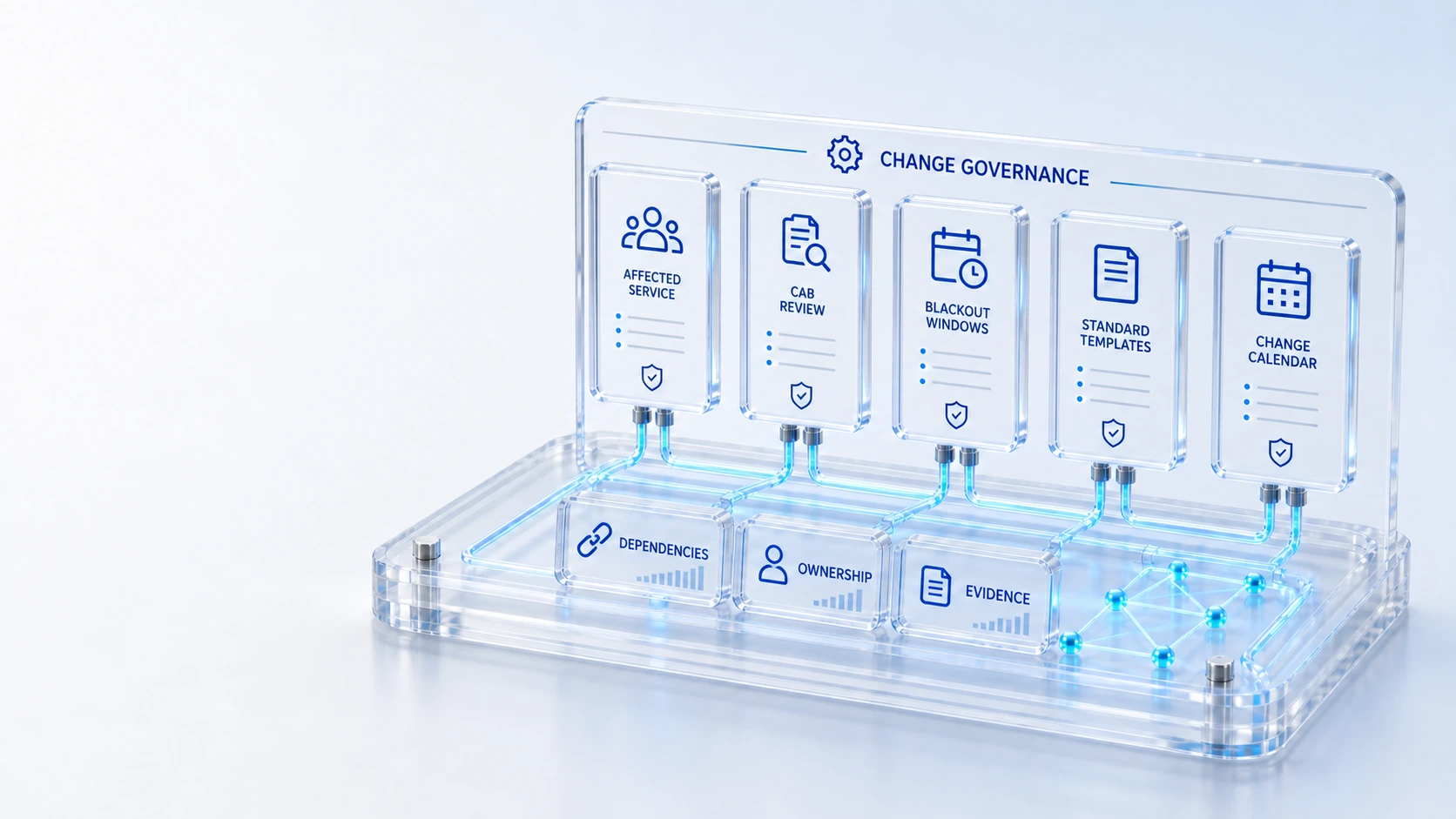
Change CoordinationConnect accountable ownership with the affected service.
CAB and CalendarsReview CAB schedules, blackout windows and change timing.
Standard TemplatesUse configured templates and the organization change calendar.
Dependency ContextInspect recorded CI relationships before making a change.
ContextReview
Coordinate changes, CAB schedules, blackout windows, standard templates and recorded dependency context.
Connect accountable ownership with the affected service.
Review CAB schedules, blackout windows and change timing.
Use configured templates and the organization change calendar.
Inspect recorded CI relationships before making a change.
Context → Review → Change
Explore the details below, then bring your workflow, source data and questions to a guided conversation.
Built into the platform
Manage priority, assignment, investigation and restoration in connected records.
Track recurring issues, root cause and known-error work.
Maintain typed classes and canonical configuration records.
Traverse recorded relationships and location ancestry.
Maintain response and resolution commitments.
Apply configured calendars and pause rules to supported workflows.
Actual product view
See the running demo environment. Features and records are subject to your role, configuration and integrations.
Connected capabilities
Unite incidents, major incidents, problems, changes and requests with service context, accountable ownership and AI assistance.
Explore 02 / infrastructureConnect typed CIs, dependencies, service portfolios, services and offerings to hardware, software and customer operations.
Explore 03 / serviceConnect configured service levels and business calendars with customer cases, incidents and recorded outage intervals.
ExploreImplementation context
Features depend on enabled modules, configured roles, source data and supported integrations. Agree your implementation scope and acceptance criteria during discovery.
Who this is for
A change request is difficult to assess when the affected service, dependencies and scheduling constraints are scattered. Teams need to bring recorded context, accountable review and planned timing together before deciding how a proposed infrastructure or service change should proceed.
Illustrative walkthrough
An illustrative operations team proposes maintenance to infrastructure supporting a shared service. The change manager reviews the affected configuration items, recorded dependencies, standard templates and calendar constraints, then coordinates the appropriate review rather than treating technical readiness as the only approval condition.
Record the proposed change and identify the affected configuration items and service relationships. Review the available dependency information with the service owner. Make uncertain or incomplete context visible so reviewers can distinguish recorded evidence from assumptions about the impact of the work.
Inspect the organization change calendar, CAB scheduling, blackout windows and applicable standard templates. Coordinate the configured review and approval responsibilities for the proposed scope. Capture the decision context so scheduling convenience does not silently replace the organization’s agreed governance process for changes.
Keep the approved or deferred decision with the change record and related work. Review activity and relevant service context as the team completes its process. Evaluate whether the final record explains responsibility and outcome without assuming that approval proves every implementation risk was removed.
Inspect the change record, affected CI relationships, calendar constraints and configured review history together. This supports a practical assessment of decision quality and ownership; it is not a guarantee that a planned change will avoid disruption.
Explore the platform
Open a workspace for a closer look.
Prepare the evaluation
These are evaluation criteria, not promised outcomes. Agree the baseline, scope, source coverage and acceptance method with the responsible owners before drawing conclusions.
Questions for this topic
A dependency view shows recorded relationships, not an assurance that every dependency has been discovered or validated. Evaluate the service model, source coverage and review process together, and record where additional investigation is needed before approving a proposed change.
The reviewed platform includes CAB schedules, blackout windows, standard templates and an organization change calendar. Agree how these support your process and configured approval responsibilities, then walk through a representative change rather than infer that every organization uses the same governance model.
Approval records an accountable decision within the agreed process. It does not eliminate implementation uncertainty or replace technical planning, validation and recovery responsibilities. Assess the quality of the context and decision evidence alongside your own procedures for executing and reviewing changes.
Your next operating chapter
Bring one workflow, one service challenge or one part of your estate. We’ll show you where Qintorava fits.