Change Governance
Coordinate changes with service dependencies.
Change GovernanceCoordinate changes with service dependencies.
Service OwnershipKeep responsibility and commitments connected.
Incident ResponseInvestigate affected CIs and technical work history.
Evidence in ContextReview recorded work and governance requirements.
ContextWork
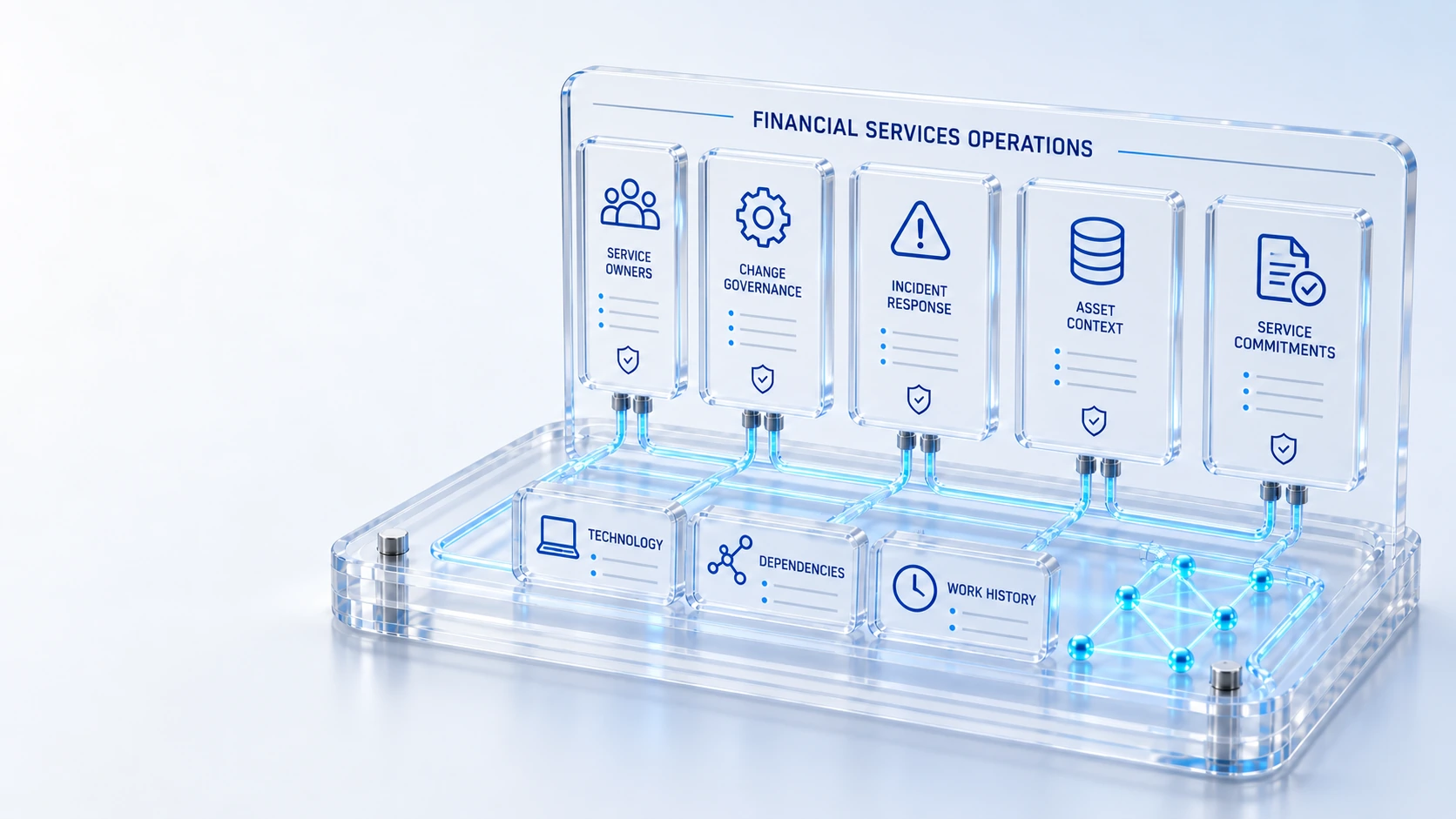
Connect change governance, service ownership, incident response and recorded commitments across financial technology operations.
Coordinate changes with service dependencies.
Keep responsibility and commitments connected.
Investigate affected CIs and technical work history.
Review recorded work and governance requirements.
Context → Work → Evidence
Use cases describe technology and service operations. Requirements and implementation scope are reviewed during discovery.
Built into the platform
Manage priority, assignment, investigation and restoration in connected records.
Track recurring issues, root cause and known-error work.
Maintain typed classes and canonical configuration records.
Traverse recorded relationships and location ancestry.
Maintain response and resolution commitments.
Apply configured calendars and pause rules to supported workflows.
Actual product view
See the running demo environment. Features and records are subject to your role, configuration and integrations.
Connected capabilities
Unite incidents, major incidents, problems, changes and requests with service context, accountable ownership and AI assistance.
Explore 02 / infrastructureConnect typed CIs, dependencies, service portfolios, services and offerings to hardware, software and customer operations.
Explore 03 / serviceConnect configured service levels and business calendars with customer cases, incidents and recorded outage intervals.
ExploreImplementation context
Industry examples illustrate technology and service operations use cases, not industry certification or regulatory compliance. Scope, integrations, access and service commitments are agreed during discovery.
Who this is for
Financial organizations depend on technology services whose incident, change and ownership records may be fragmented across teams. An operating review needs clear relationships and accountable decisions while keeping regulatory obligations, business transaction processing and contractual resilience requirements separate from the platform’s demonstrated technology service capabilities.
Illustrative walkthrough
An illustrative financial technology team investigates an interruption in infrastructure supporting a payment-related service. Responders review recorded dependencies and ownership, while the change manager evaluates any proposed remedial work against calendar and review constraints before the service owner considers the appropriate operational handback.
Start with the incident, affected configuration item and recorded service relationships. Involve the responsible technology service owner and distinguish observed impact from assumptions about payment activity. The evaluation focuses on the supporting technology workflow rather than transaction processing, financial advice or a claim that all business dependencies are discovered.
Inspect the operational evidence and any proposed change with the relevant responders and reviewers. Use configured CAB, calendar, blackout or template context where applicable. Preserve the decision responsibility and unresolved uncertainty so pressure to restore a service does not erase the need to explain the next authorized technical action.
Review incident history, relevant service targets and the supporting decision records with the service owner. Distinguish operational restoration from broader financial resilience and regulatory responsibilities. Agree which evidence and measures matter to the organization before treating a demonstration workflow as proof of compliance or a contractual service outcome.
Inspect the service ownership, recorded dependencies, incident context and change review evidence for the chosen technology journey. This supports operational evaluation but does not establish banking functionality, regulatory authorization, industry certification or assured availability of payment and financial services.
Explore the platform
Open a workspace for a closer look.
Prepare the evaluation
These are evaluation criteria, not promised outcomes. Agree the baseline, scope, source coverage and acceptance method with the responsible owners before drawing conclusions.
Questions for this topic
This industry example concerns technology and service operations supporting financial organizations. It does not describe payment processing, banking transaction execution or financial advice. Evaluate the platform’s demonstrated service, configuration and governance capabilities separately from the organization’s specialized financial systems and regulated business responsibilities.
No. Applicable regulations, control evidence and contractual resilience requirements must be assessed for the particular organization and implementation. The website does not assert an unverified certification or authorization. Use discovery to identify the relevant review questions and request the evidence needed for your due diligence.
Choose a representative supporting technology service with named owners, relevant incident and change work, and meaningful configuration relationships. Inspect source coverage and uncertainty alongside the workflow. Agree candidate measures and acceptance criteria with the responsible operational and control teams rather than assume a generic demonstration proves critical-service readiness.
Your next operating chapter
Bring one workflow, one service challenge or one part of your estate. We’ll show you where Qintorava fits.