Service Commitments
Maintain response and resolution targets.
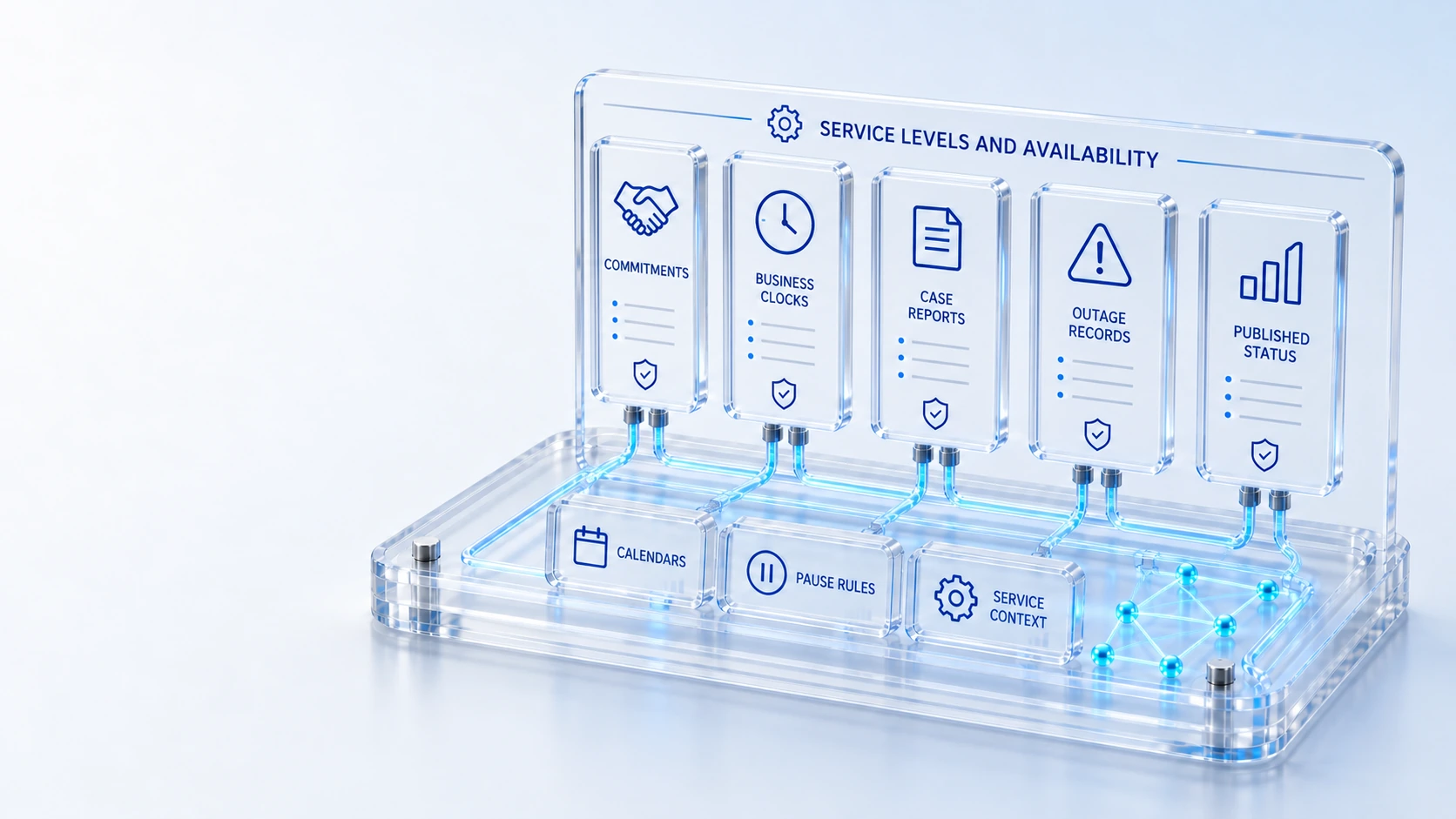
Service CommitmentsMaintain response and resolution targets.
Business CalendarsApply working clocks and pause rules.
Recorded OutagesDistinguish interruption, maintenance and degradation.
Customer CommunicationConnect status with cases and technical response.
CommitmentClock
Separate recorded outage intervals, customer status, maintenance and response commitments while connecting their work.
Maintain response and resolution targets.
Apply working clocks and pause rules.
Distinguish interruption, maintenance and degradation.
Connect status with cases and technical response.
Commitment → Clock → Evidence
Explore the details below, then bring your workflow, source data and questions to a guided conversation.
Built into the platform
Maintain response and resolution commitments.
Apply configured calendars and pause rules to supported workflows.
Validate customer, contact and affected-CI relationships.
Match configured contracts and service coverage.
Review operational events in a focused surface.
Track severity, acknowledgment and ownership.
Actual product view
See the running demo environment. Features and records are subject to your role, configuration and integrations.
Connected capabilities
Connect configured service levels and business calendars with customer cases, incidents and recorded outage intervals.
Explore 02 / customerConnect account context, installed assets, entitlements, business service levels, playbooks, major cases and technical recovery.
Explore 03 / infrastructureInvestigate events and alerts with affected CIs, ownership and linked incident evidence.
ExploreImplementation context
Features depend on enabled modules, configured roles, source data and supported integrations. Agree your implementation scope and acceptance criteria during discovery.
Who this is for
Response targets, outage intervals and published service status answer different questions, yet they are often treated as one measure. Teams need to connect customer commitments and operational evidence while preserving the definitions, business clocks and recorded intervals that make each service report meaningful.
Illustrative walkthrough
In this illustrative scenario, a customer-facing service experiences a recorded interruption. The service owner reviews outage and maintenance context alongside the relevant case targets and business calendar, then evaluates customer communication and availability reporting without confusing response performance with the measured interruption itself.
Identify the service, affected customer context and the specific response or availability question. Review the configured commitment and relevant business clock. Distinguish a case response target from an outage duration before selecting records or interpreting a report, so evaluators know which definition and responsibility they are assessing.
Inspect outage records, maintenance context and associated operational events or cases where relevant. Check the source and interval information supporting the report. Preserve uncertainty about incomplete records rather than assuming that absence of an outage entry proves uninterrupted availability or that every operational alert represents a customer-facing outage.
Review case SLA and availability information with the service owner and the appropriate customer status context. Agree how the findings should be communicated and which gaps require follow-up. Keep contractual commitments and reporting definitions explicit instead of turning one demonstration report into a universal uptime or response guarantee.
Inspect business calendars, service targets, recorded outage intervals, status and the associated report definitions. These support a clearer service review; they do not establish an unqualified uptime guarantee or make response compliance interchangeable with the availability of a service.
Explore the platform
Open a workspace for a closer look.
Prepare the evaluation
These are evaluation criteria, not promised outcomes. Agree the baseline, scope, source coverage and acceptance method with the responsible owners before drawing conclusions.
Questions for this topic
No. Response targets measure a defined service interaction against configured clocks, while availability reporting depends on the relevant recorded service intervals and definitions. Evaluate the two responsibilities separately and then inspect how their records connect for the customer and service owner’s review.
An alert is an operational signal requiring appropriate interpretation. It does not automatically establish customer impact, outage timing or the reporting treatment for maintenance. Review the affected service, recorded interruption and relevant work before using an alert as evidence in an availability discussion.
No. Contractual service commitments and their measurement definitions must be agreed with Qintorava for the relevant implementation. The demonstration helps inspect service targets, business clocks and reporting context, but it does not establish a universal guarantee of response performance or uninterrupted availability.
Your next operating chapter
Bring one workflow, one service challenge or one part of your estate. We’ll show you where Qintorava fits.