Rack and Asset Context
Relate allocations and customer equipment.
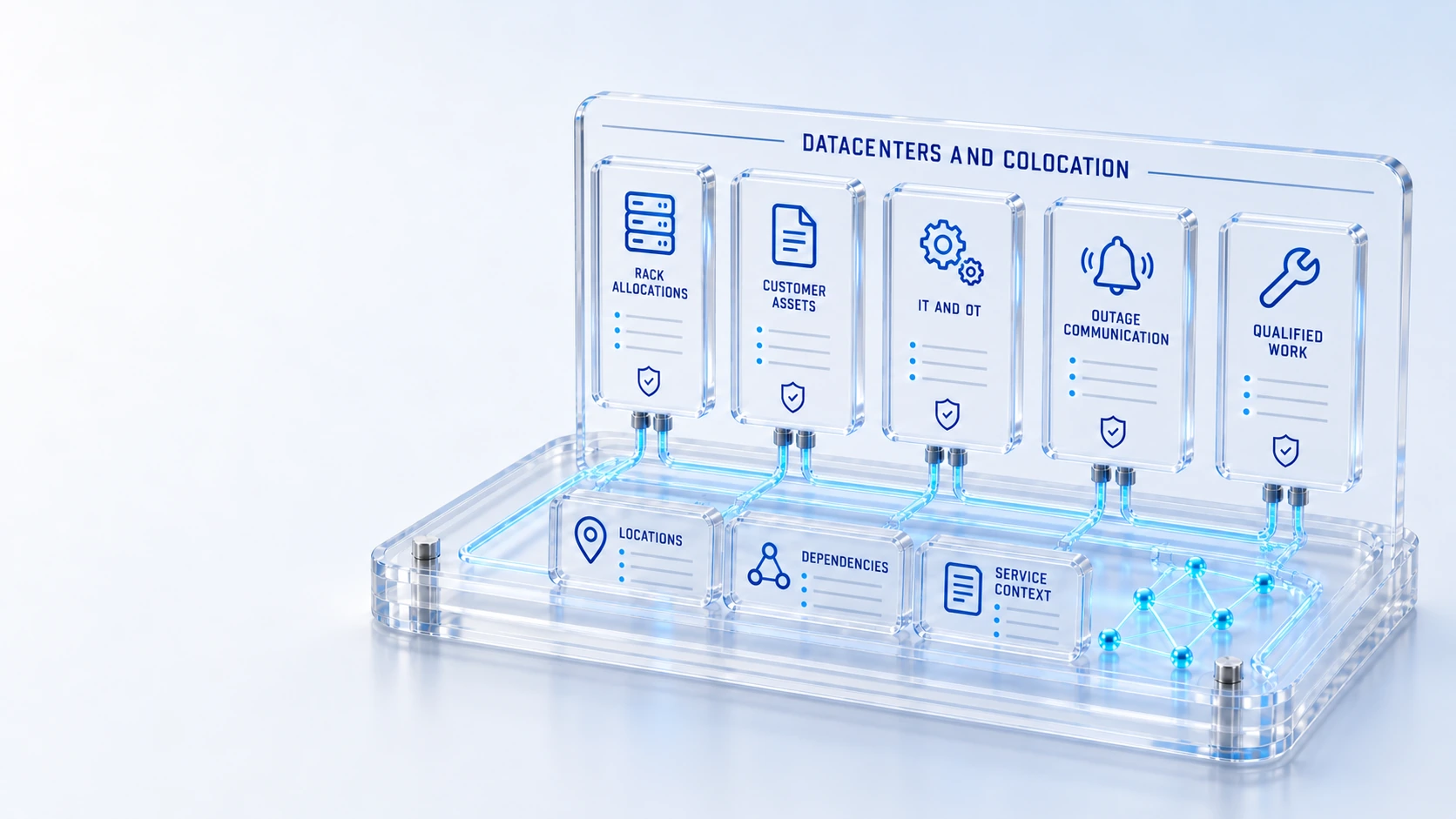
Rack and Asset ContextRelate allocations and customer equipment.
IT and OT RelationshipsTrace compute, network, power and cooling dependencies.
Outage CommunicationConnect customer and technical work.
Qualified WorkCoordinate coverage and completion evidence.
ContextWork
Bring rack allocations, installed assets, IT/OT dependencies, outage communication and qualified work into one operating picture.
Relate allocations and customer equipment.
Trace compute, network, power and cooling dependencies.
Connect customer and technical work.
Coordinate coverage and completion evidence.
Context → Work → Evidence
Use cases describe technology and service operations. Requirements and implementation scope are reviewed during discovery.
Built into the platform
Relate campus, site, building, floor, room and rack.
Distinguish compute, network, power, cooling and shared equipment.
Validate customer, contact and affected-CI relationships.
Match configured contracts and service coverage.
Maintain response and resolution commitments.
Apply configured calendars and pause rules to supported workflows.
Actual product view
See the running demo environment. Features and records are subject to your role, configuration and integrations.
Connected capabilities
Connect facilities, customer equipment, IT/OT CIs, capacity, qualified work and service impact in a datacenter operating workspace.
Explore 02 / customerConnect account context, installed assets, entitlements, business service levels, playbooks, major cases and technical recovery.
Explore 03 / serviceConnect configured service levels and business calendars with customer cases, incidents and recorded outage intervals.
ExploreImplementation context
Industry examples illustrate technology and service operations use cases, not industry certification or regulatory compliance. Scope, integrations, access and service commitments are agreed during discovery.
Who this is for
Colocation services connect customer commitments to shared facilities, rack allocation and installed equipment. Teams need to understand the recorded physical and service relationships before coordinating incidents, status and qualified work, while keeping contractual availability, customer acceptance and actual facilities condition distinct from the platform’s demonstration records.
Illustrative walkthrough
An illustrative colocation operator evaluates a customer case involving installed equipment in a recorded rack allocation. The service team reviews the physical context, dependencies and outage information, then coordinates qualified work and inspects evidence before the responsible owner reviews communication and service handback.
Identify the customer case, relevant equipment and recorded site, room or rack allocation. Inspect service and IT/OT relationships where available. Confirm the ownership and source coverage of the model before assuming the displayed allocation reflects every current physical condition or customer obligation within the facility.
Relate the case to technical incidents, recorded outage context and the appropriate on-site work. Review coverage, work plans and execution responsibilities with the relevant teams. Preserve the distinction between a customer-facing case, physical maintenance and technical recovery so each part of the service journey remains accountable.
Inspect completion evidence alongside recorded outage intervals, service commitments and communication context. Agree which questions require customer or facilities confirmation before handback. A completed work task or an illustrative report should not be presented as proof of contractual uptime, full customer acceptance or uninterrupted physical infrastructure operation.
Inspect rack allocation, installed assets, service relationships, outage context and qualified work evidence together. This supports evaluation of connected colocation operations; it does not establish real-time facilities control, guaranteed capacity, universal availability commitments or a customer’s contractual acceptance of service.
Explore the platform
Open a workspace for a closer look.
Prepare the evaluation
These are evaluation criteria, not promised outcomes. Agree the baseline, scope, source coverage and acceptance method with the responsible owners before drawing conclusions.
Questions for this topic
It shows recorded allocation and equipment context within the available model. Physical capacity and conditions still require the operator’s validation and applicable engineering process. Evaluate the data source, ownership and currency before using an allocation view as the sole basis for a customer capacity commitment.
No. Case response measures and service availability use different definitions and evidence. Review the configured business clocks, recorded outage intervals and applicable agreement with the service owner. Connecting their records should clarify the conversation rather than collapse separate commitments into a single ambiguous performance measure.
No. Availability commitments and their measurement definitions must be confirmed in the relevant written agreement and implementation scope. The demonstration helps inspect physical, customer and operational context but cannot establish a universal guarantee about facilities resilience, uninterrupted service or the performance of a particular colocation environment.
Your next operating chapter
Bring one workflow, one service challenge or one part of your estate. We’ll show you where Qintorava fits.