Assess the Starting Point
Map workflows, source systems and boundaries.
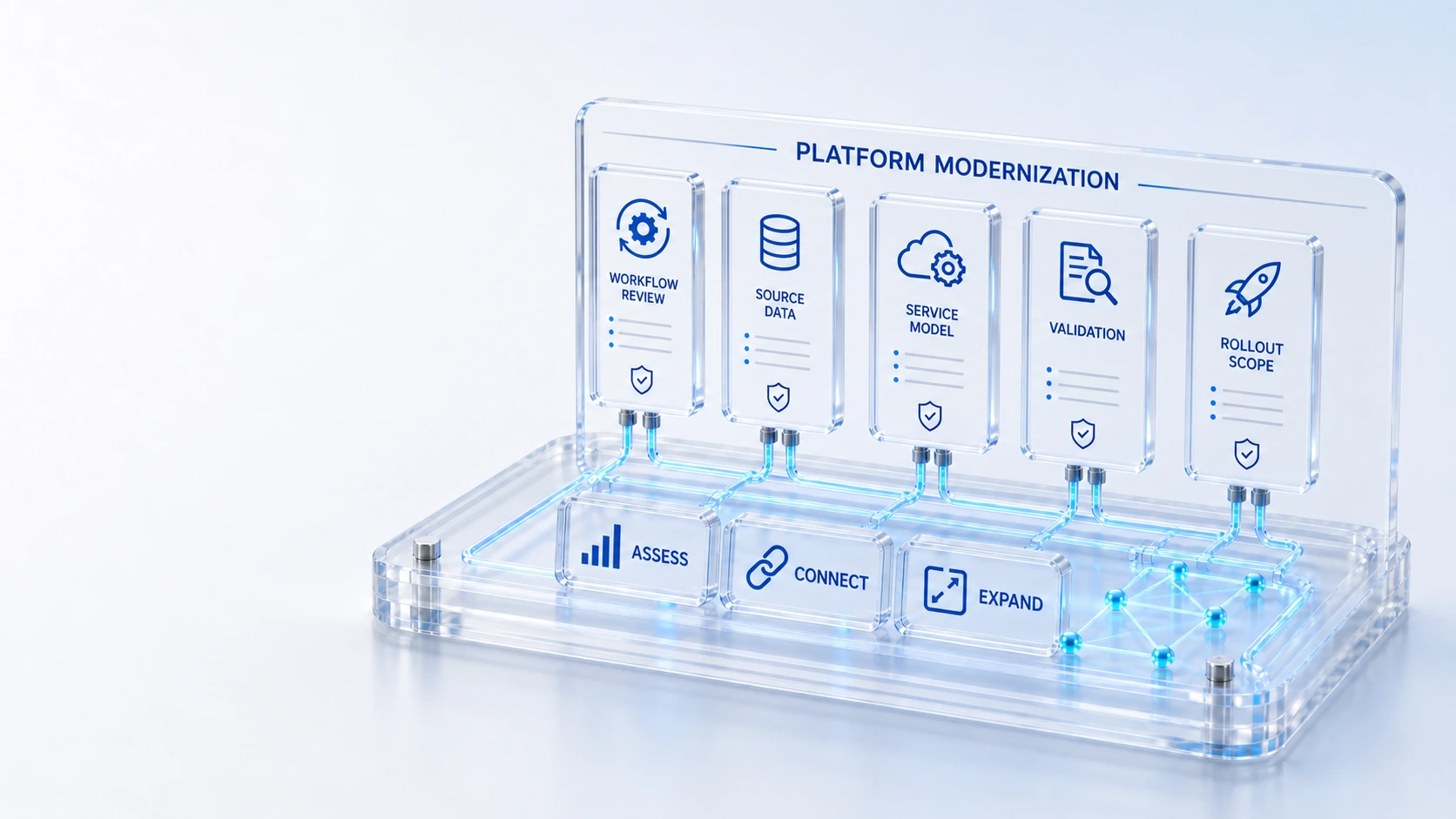
Assess the Starting PointMap workflows, source systems and boundaries.
Prepare the Service ModelInspect discovery, CIs and dependencies.
Validate One JourneyTest against measurable acceptance criteria.
Expand DeliberatelyAgree data quality and rollout responsibilities.
AssessValidate
Assess your data and integrations, map the service model, and validate a focused operational journey before expanding.
Map workflows, source systems and boundaries.
Inspect discovery, CIs and dependencies.
Test against measurable acceptance criteria.
Agree data quality and rollout responsibilities.
Assess → Validate → Expand
Explore the details below, then bring your workflow, source data and questions to a guided conversation.
Built into the platform
Maintain provider and infrastructure discovery configuration.
Define discovery behavior for supported sources.
Maintain typed classes and canonical configuration records.
Traverse recorded relationships and location ancestry.
Manage priority, assignment, investigation and restoration in connected records.
Track recurring issues, root cause and known-error work.
Actual product view
See the running demo environment. Features and records are subject to your role, configuration and integrations.
Connected capabilities
Configure discovery sources, patterns, ranges and schedules, then reconcile confirmed inventory into the shared CMDB.
Explore 02 / infrastructureConnect typed CIs, dependencies, service portfolios, services and offerings to hardware, software and customer operations.
Explore 03 / serviceUnite incidents, major incidents, problems, changes and requests with service context, accountable ownership and AI assistance.
ExploreImplementation context
Features depend on enabled modules, configured roles, source data and supported integrations. Agree your implementation scope and acceptance criteria during discovery.
Who this is for
Modernization is risky when broad feature comparisons hide data quality, identity mapping and workflow dependencies. Teams need a bounded evaluation that makes source coverage, ownership and integration requirements explicit before deciding what to migrate, what to retain and how to validate the first connected operating journey.
Illustrative walkthrough
In this illustrative scenario, an organization evaluates a first service workflow using representative records from its existing environment. The team maps key identities and configuration context, inspects roles and handoffs, and agrees acceptance criteria before planning wider adoption or the retirement of other systems.
Choose one meaningful workflow and identify its users, source systems, records and accountable owners. Review the data quality and integration requirements before defining migration scope. Separate what must move for the evaluation from history or specialist functions that may appropriately remain in an existing system.
Inspect how representative records relate to the canonical configuration and service model. Review discovery or reconciliation context where applicable and test the intended roles and permissions. Keep conflicts, missing relationships and unsupported interfaces visible so the evaluation does not rely on a deceptively complete sample without operational relevance.
Walk through the connected journey and review ownership, evidence and exceptions with the process owners. Record the acceptance criteria and remaining prerequisites for implementation. Use those findings to shape a phased plan instead of assuming that a successful demonstration authorizes an automatic, complete migration of every existing workflow.
Inspect data mapping, representative record relationships, role behavior and workflow handoffs within an agreed scope. These support migration planning; they do not establish an automatic conversion tool, complete historical import or guaranteed replacement of every incumbent capability and integration.
Explore the platform
Open a workspace for a closer look.
Prepare the evaluation
These are evaluation criteria, not promised outcomes. Agree the baseline, scope, source coverage and acceptance method with the responsible owners before drawing conclusions.
Questions for this topic
The website does not establish an automatic conversion capability for every incumbent system or custom process. Assess source data, configuration, integration interfaces and workflow requirements during discovery. Use representative records and agreed acceptance criteria to determine a practical migration or coexistence plan for your organization.
That decision depends on operational, contractual and retention requirements. Identify which records and relationships are needed for the first workflow and which history may remain in an existing system. Validate the agreed approach with the responsible data, process and legal owners before planning broader movement.
Include representative exceptions, incomplete relationships and realistic roles rather than only ideal records. Inspect handoffs, evidence and integration boundaries with the people who own the process. A useful evaluation exposes prerequisites and limitations so rollout decisions are based on observed fit and explicit acceptance criteria.
Your next operating chapter
Bring one workflow, one service challenge or one part of your estate. We’ll show you where Qintorava fits.