Cloud Estate
Track configured provider scopes and connection verification separately.
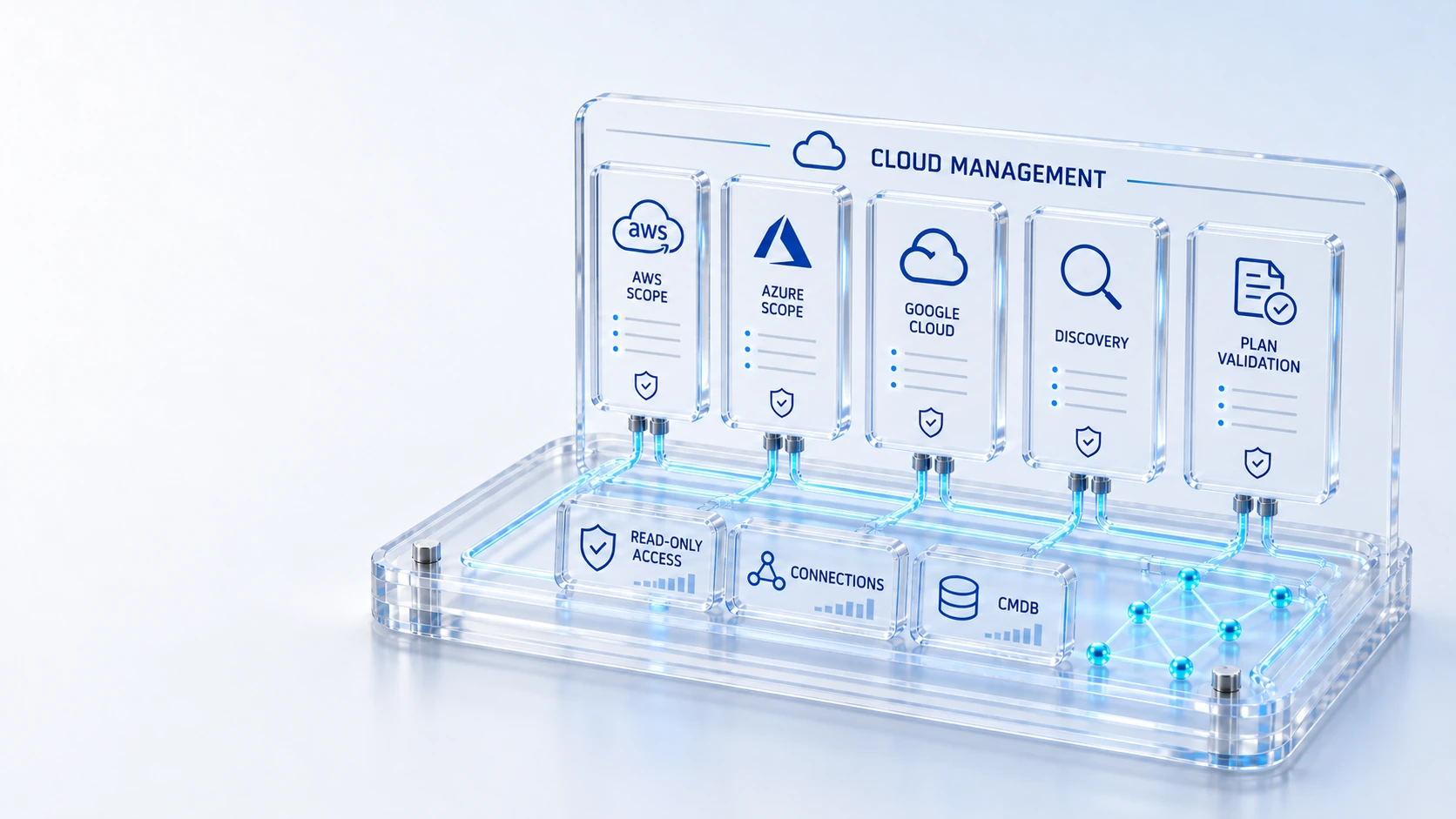
Cloud EstateTrack configured provider scopes and connection verification separately.
Intent and PlansCreate and locally validate structured infrastructure plans.
Discovery SourcesMaintain provider and infrastructure discovery configuration.
PatternsDefine discovery behavior for supported sources.
ConfigureVerify
Configure discovery, verify read-only connections and validate infrastructure plans with explicit evidence.
Track configured provider scopes and connection verification separately.
Create and locally validate structured infrastructure plans.
Maintain provider and infrastructure discovery configuration.
Define discovery behavior for supported sources.
Configure → Verify → Validate
Explore the details below, then bring your workflow, source data and questions to a guided conversation.
Built into the platform
Track configured provider scopes and connection verification separately.
Create and locally validate structured infrastructure plans.
Maintain provider and infrastructure discovery configuration.
Define discovery behavior for supported sources.
Maintain typed classes and canonical configuration records.
Traverse recorded relationships and location ancestry.
Actual product view
See the running demo environment. Features and records are subject to your role, configuration and integrations.
Connected capabilities
Configure AWS, Azure and Google Cloud scopes, verify read-only connections, discover resources and validate infrastructure intent.
Explore 02 / infrastructureConfigure discovery sources, patterns, ranges and schedules, then reconcile confirmed inventory into the shared CMDB.
Explore 03 / infrastructureConnect typed CIs, dependencies, service portfolios, services and offerings to hardware, software and customer operations.
ExploreImplementation context
Features depend on enabled modules, configured roles, source data and supported integrations. Agree your implementation scope and acceptance criteria during discovery.
Who this is for
Cloud resources are difficult to govern when provider access, discovery data and planned operations are discussed independently. Teams need to establish which scopes are connected, what has been verified and how discovered context relates to configuration records before reviewing work against the estate.
Illustrative walkthrough
An illustrative platform team wants to evaluate a cloud scope before considering operational work. It configures the provider context, reviews read-only connection verification and discovery evidence, then examines plan validation with the service owner so data availability and permissions remain explicit.
Identify the AWS, Azure or Google Cloud scope relevant to the evaluation and review the required provider configuration. Inspect read-only connection verification before interpreting the results. Record which permissions and source boundaries were tested rather than assuming a connected provider exposes every possible resource.
Review discovered resources, source lineage and the corresponding CMDB reconciliation context. Check ownership and relationships for the service being evaluated. Keep incomplete or conflicting data visible so the team can decide what must be reconciled before relying on the model for operational decisions.
Inspect the proposed intent and plan validation with the appropriate operational owner. Separate evidence that a plan was validated from authorization or execution of that plan. Agree any subsequent work, access and review requirements within the implementation scope rather than infer them from the preview.
Inspect provider verification, discovered scope, reconciliation evidence and the validation result together. The evaluation should explain what was tested and what remains outside the boundary, without treating read-only verification as proof of unrestricted operational execution.
Explore the platform
Open a workspace for a closer look.
Prepare the evaluation
These are evaluation criteria, not promised outcomes. Agree the baseline, scope, source coverage and acceptance method with the responsible owners before drawing conclusions.
Questions for this topic
No. Provider configuration, read-only verification, discovery and plan validation are distinct capabilities. Review the actual permissions, enabled modules and authorized workflow for your implementation. A successful connection check is not permission to execute every action in a provider environment.
The reviewed platform connects shared discovery with CMDB reconciliation and resource lineage. Evaluate identification rules, source coverage and ownership using representative data so you can determine how discovered items relate to canonical configuration records and where conflicts require additional review.
Each provider has its own configuration, permissions and available evidence. Confirm the specific accounts, subscriptions or projects, required access and supported functions during discovery. Do not assume that verifying one provider establishes identical coverage or execution behavior for every other provider.
Your next operating chapter
Bring one workflow, one service challenge or one part of your estate. We’ll show you where Qintorava fits.