Incident and Major Incident Response
Manage priority, assignment, investigation and restoration in connected records.
Incident and Major Incident ResponseManage priority, assignment, investigation and restoration in connected records.
Problem ManagementTrack recurring issues, root cause and known-error work.
Executive WorkspaceReview inventory, capital exposure and lifecycle exceptions.
Model Catalog and StockroomsManage hardware models and stored inventory.
ServiceContext
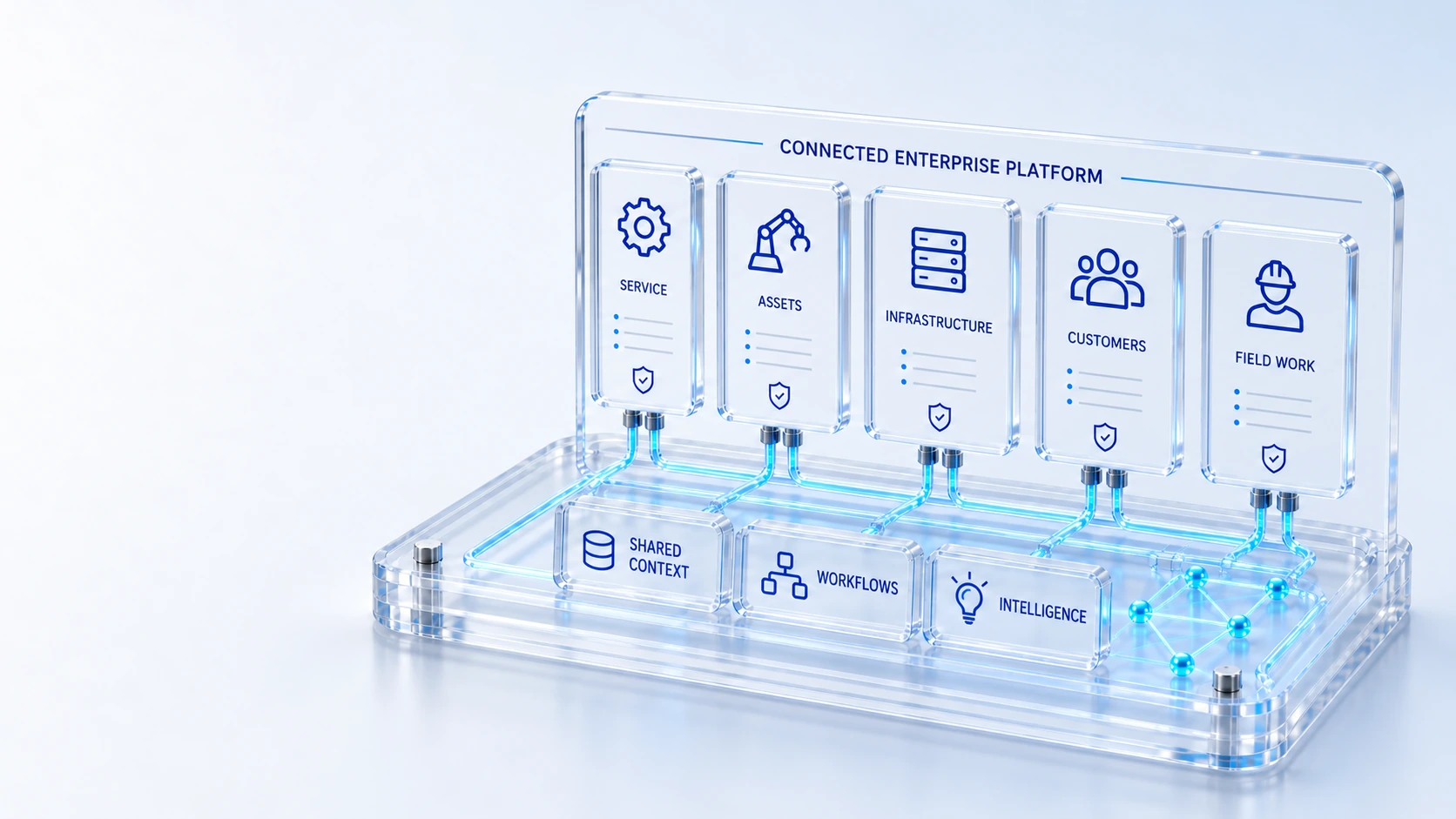
Unite service workflows, assets and cloud context with a shared operational foundation.
Manage priority, assignment, investigation and restoration in connected records.
Track recurring issues, root cause and known-error work.
Review inventory, capital exposure and lifecycle exceptions.
Manage hardware models and stored inventory.
Service → Context → Action
Explore the details below, then bring your workflow, source data and questions to a guided conversation.
Built into the platform
Manage priority, assignment, investigation and restoration in connected records.
Track recurring issues, root cause and known-error work.
Review inventory, capital exposure and lifecycle exceptions.
Manage hardware models and stored inventory.
Track configured provider scopes and connection verification separately.
Create and locally validate structured infrastructure plans.
Actual product view
See the running demo environment. Features and records are subject to your role, configuration and integrations.
Connected capabilities
Unite incidents, major incidents, problems, changes and requests with service context, accountable ownership and AI assistance.
Explore 02 / assetsConnect procurement, custody, inventory, stockrooms, warranty, leases, maintenance, disposal and employee recovery to the same hardware CIs.
Explore 03 / infrastructureConfigure AWS, Azure and Google Cloud scopes, verify read-only connections, discover resources and validate infrastructure intent.
ExploreImplementation context
Features depend on enabled modules, configured roles, source data and supported integrations. Agree your implementation scope and acceptance criteria during discovery.
Who this is for
Enterprise IT work crosses service queues, equipment ownership, cloud scopes and infrastructure relationships. Fragmented records make teams repeat investigation and lose responsibility at the handoff. A practical operating model connects the relevant context while letting each discipline keep the controls and ownership appropriate to its work.
Illustrative walkthrough
In this illustrative scenario, an employee reports an issue involving assigned equipment and a shared service. The service team reviews the request, related asset and configuration context, then works with infrastructure or cloud owners to define the next responsible step rather than opening disconnected investigations.
Start with the employee’s request or incident and identify the responsible service team. Review the associated hardware, configuration item and recorded service relationships where available. Confirm the relevant ownership before expanding the investigation so each team understands which part of the work it is accountable for.
Use the connected record context to involve asset, infrastructure or cloud owners as the situation requires. Review provider scope, lifecycle exposure or service dependencies through the appropriate workspace. Preserve configured access and review responsibilities rather than exposing every enterprise record to everyone participating in the investigation.
Record the decision, assigned work and available evidence in the relevant operational context. Use the walkthrough to identify data-quality and integration gaps before expanding scope. Evaluate whether handoffs remain understandable to each owner instead of assuming that a broad platform automatically fixes every operating-model problem.
Inspect how service work, asset responsibility and infrastructure or cloud context connect for one realistic journey. Use observed gaps to shape the evaluation scope; do not infer organization-wide productivity or cost outcomes from a single connected demonstration.
Explore the platform
Open a workspace for a closer look.
Prepare the evaluation
These are evaluation criteria, not promised outcomes. Agree the baseline, scope, source coverage and acceptance method with the responsible owners before drawing conclusions.
Questions for this topic
The evaluation can begin with a bounded workflow and representative data, then assess which connected capabilities add value. Agree migration, coexistence, integrations and acceptance criteria explicitly. The website does not establish a requirement to replace every existing tool in a single implementation.
No. Service, asset, infrastructure and cloud teams still need defined responsibilities and appropriate access. The connected foundation helps relate their records and work. Evaluate whether the handoffs and decisions are clearer while preserving the discipline-specific controls and expertise your organization requires.
Choose an operating journey, define the participating roles and inspect the available records, handoffs and evidence. Identify data quality and integration prerequisites, then agree candidate measures and acceptance criteria. Avoid relying on a generic capability checklist without testing the work your teams actually perform.
Your next operating chapter
Bring one workflow, one service challenge or one part of your estate. We’ll show you where Qintorava fits.