Account-Aware Intake
Relate cases to customer, contact, asset and coverage.
Account-Aware IntakeRelate cases to customer, contact, asset and coverage.
Commitments in ContextApply configured service levels and business clocks.
Technical RecoveryConnect incident response without losing case ownership.
Qualified HandbackBring field completion evidence back for support review.
CaseTechnical response
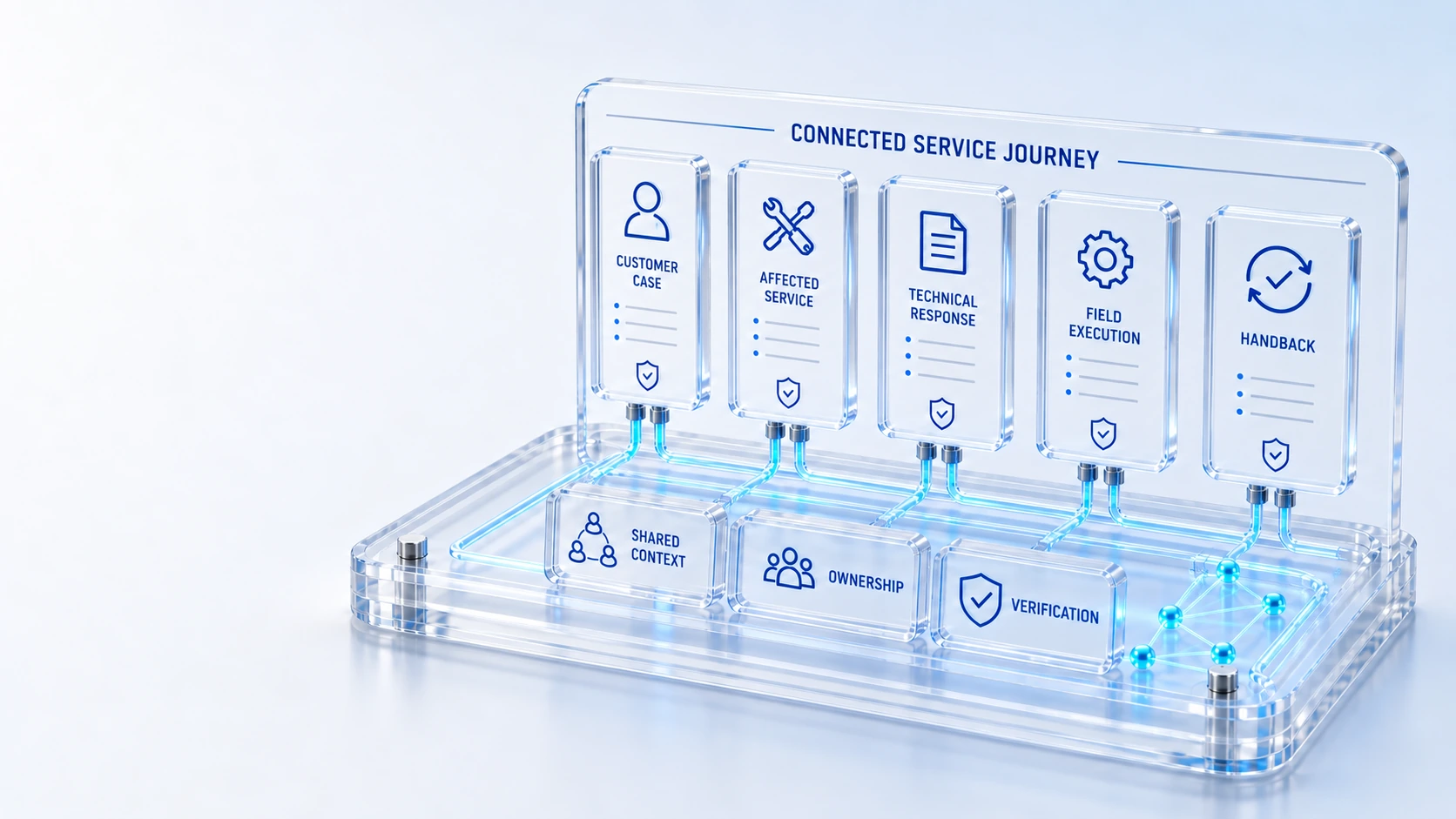
Unite case ownership, entitlement, incident recovery and field execution in one connected service journey.
Relate cases to customer, contact, asset and coverage.
Apply configured service levels and business clocks.
Connect incident response without losing case ownership.
Bring field completion evidence back for support review.
Case → Technical response → Handback
Explore the details below, then bring your workflow, source data and questions to a guided conversation.
Built into the platform
Validate customer, contact and affected-CI relationships.
Match configured contracts and service coverage.
Maintain response and resolution commitments.
Apply configured calendars and pause rules to supported workflows.
Check skills, expiry, coverage, workload and resource absence.
Use published plans, dependencies and required checklists.
Actual product view
See the running demo environment. Features and records are subject to your role, configuration and integrations.
Connected capabilities
Connect account context, installed assets, entitlements, business service levels, playbooks, major cases and technical recovery.
Explore 02 / serviceConnect configured service levels and business calendars with customer cases, incidents and recorded outage intervals.
Explore 03 / customerCoordinate qualified dispatch, work orders, appointments, recurring schedules and verified completion with cases and incidents.
ExploreImplementation context
Features depend on enabled modules, configured roles, source data and supported integrations. Agree your implementation scope and acceptance criteria during discovery.
Who this is for
A customer problem may need account-aware support, technical restoration and an on-site visit, but each team can lose context at the handoff. The challenge is to keep coverage, ownership and evidence connected while preserving the distinct responsibilities of customer, technical and field work.
Illustrative walkthrough
In this illustrative scenario, a customer reports a service problem involving installed equipment. Support reviews the account and recorded entitlement, relates the case to technical response and coordinates qualified field work where needed before reviewing completion evidence and communicating the service handback.
Capture the account-scoped case and inspect coverage, entitlement and configured service targets. Use the relevant case playbook and customer context to identify responsible support ownership. Do not assume that a technical incident alone contains the customer’s contractual coverage or communication needs for this specific issue.
Relate the case to the affected service, configuration item and technical incident where appropriate. If on-site work is required, review qualified coverage, work plans and appointment context. Preserve each team’s responsibility so a case handoff does not blur technical recovery with field completion.
Inspect execution evidence and the verification or handback state of field work alongside technical recovery context. Keep support ownership of the customer follow-up. Evaluate whether the final case explains what was done and what remains open before treating completion as an accepted customer outcome.
Inspect the case, coverage, technical link, qualified work and verification evidence as a connected journey. A useful demonstration should preserve each team’s accountability and customer context without implying that a closed technical task automatically fulfills every service commitment.
Explore the platform
Open a workspace for a closer look.
Prepare the evaluation
These are evaluation criteria, not promised outcomes. Agree the baseline, scope, source coverage and acceptance method with the responsible owners before drawing conclusions.
Questions for this topic
A case represents account-aware customer service work, including coverage and communication context. An internal incident represents technical response and restoration work. Evaluate how the records connect while retaining their separate owners, responsibilities and evidence rather than trying to collapse them into one workflow.
No. Use the service context and technical investigation to determine the appropriate path. Where qualified on-site work is required, evaluate coverage, work planning, evidence and handback. The connected workflow should also support cases that remain entirely within customer support and technical response.
Agree the relevant technical, field and customer review criteria during discovery. Inspect completion evidence and unresolved work before deciding on handback. A field task status or incident closure is useful context, but it should not silently replace the organization’s customer follow-up and verification responsibilities.
Your next operating chapter
Bring one workflow, one service challenge or one part of your estate. We’ll show you where Qintorava fits.