Incident and Major Incident Response
Manage priority, assignment, investigation and restoration in connected records.
Incident and Major Incident ResponseManage priority, assignment, investigation and restoration in connected records.
Problem ManagementTrack recurring issues, root cause and known-error work.
Account-Aware CasesValidate customer, contact and affected-CI relationships.
Coverage and EntitlementsMatch configured contracts and service coverage.
CaseTechnical response
Connect internal service operations, customer cases and qualified field execution.
Manage priority, assignment, investigation and restoration in connected records.
Track recurring issues, root cause and known-error work.
Validate customer, contact and affected-CI relationships.
Match configured contracts and service coverage.
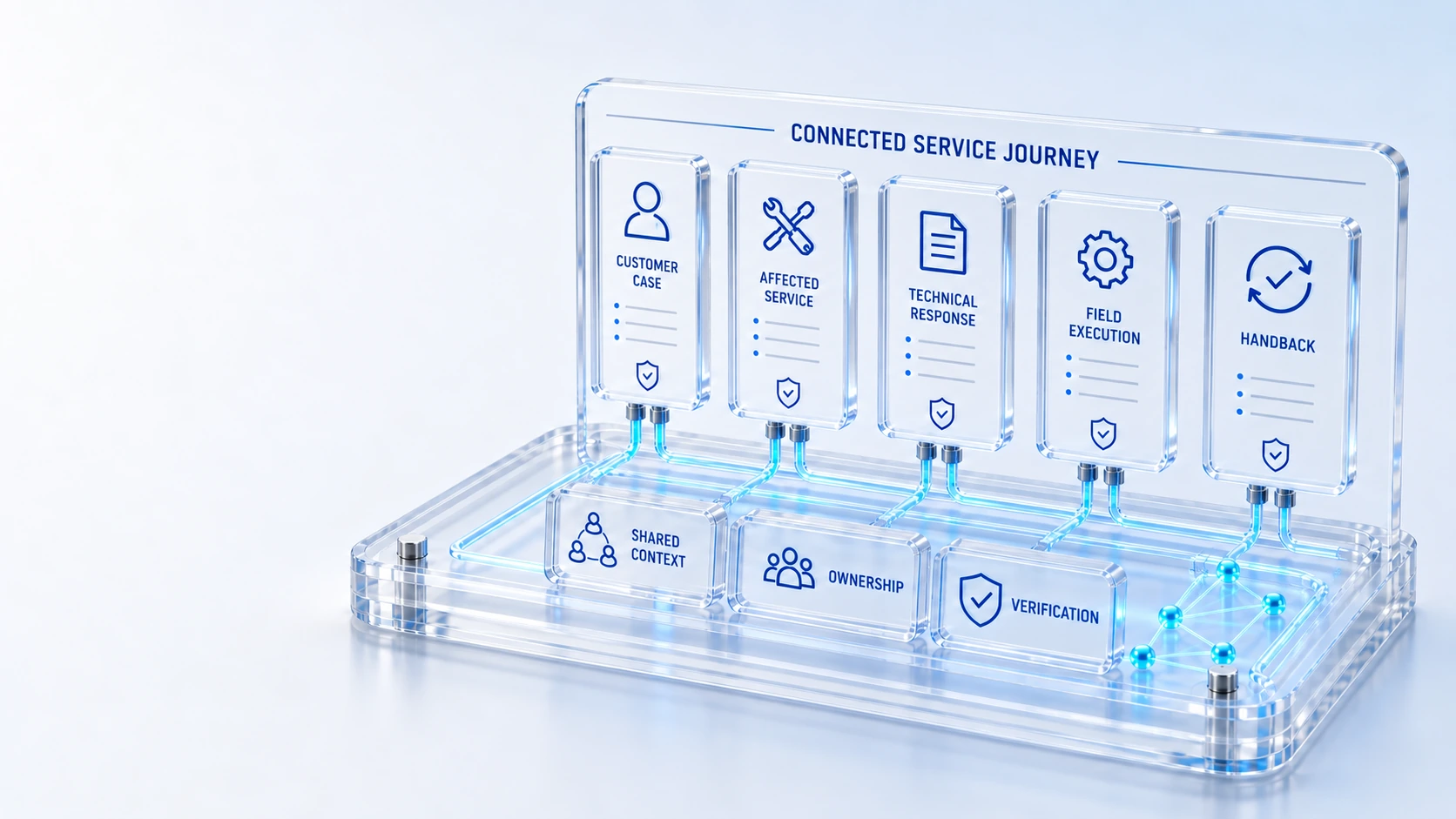
Case → Technical response → Handback
Explore the details below, then bring your workflow, source data and questions to a guided conversation.
Built into the platform
Manage priority, assignment, investigation and restoration in connected records.
Track recurring issues, root cause and known-error work.
Validate customer, contact and affected-CI relationships.
Match configured contracts and service coverage.
Check skills, expiry, coverage, workload and resource absence.
Use published plans, dependencies and required checklists.
Actual product view
See the running demo environment. Features and records are subject to your role, configuration and integrations.
Connected capabilities
Unite incidents, major incidents, problems, changes and requests with service context, accountable ownership and AI assistance.
Explore 02 / customerConnect account context, installed assets, entitlements, business service levels, playbooks, major cases and technical recovery.
Explore 03 / customerCoordinate qualified dispatch, work orders, appointments, recurring schedules and verified completion with cases and incidents.
ExploreImplementation context
Features depend on enabled modules, configured roles, source data and supported integrations. Agree your implementation scope and acceptance criteria during discovery.
Who this is for
A customer-facing issue can cross internal technology, supplier and field responsibilities before it is resolved. Separate tools and records often obscure the relationship between the customer promise and the actual work. Organizations need connected context without erasing the boundaries that make each handoff accountable.
Illustrative walkthrough
An illustrative enterprise evaluates an issue that starts with a customer case and requires technical investigation and qualified on-site work. The process owner follows the relationship between the customer, service, equipment and delivery teams while testing whether evidence and responsibility survive each handoff.
Define the starting customer or internal service need and identify the records and roles involved. Review account, service and equipment context before deciding which teams participate. Keep the initial journey specific enough that evaluators can inspect real handoffs rather than only a general platform overview.
Relate customer service to technical response and qualified field execution where the scenario requires them. Inspect the source records in each workspace and the access permitted to the participating roles. Preserve their separate decisions so one team’s completion does not silently close another team’s unresolved responsibility.
Bring the execution evidence, technical state and customer follow-up into the final process review. Identify where information or ownership failed to transfer clearly. Use those findings to agree a practical implementation boundary and candidate acceptance measures before extending the same pattern to other parts of the enterprise.
Inspect the customer-to-technical-to-field relationships, ownership and completion evidence as one operating journey. The goal is a clearer evaluation of connected work, not an unsupported claim that every enterprise process is already automated or that organizational boundaries disappear.
Explore the platform
Open a workspace for a closer look.
Prepare the evaluation
These are evaluation criteria, not promised outcomes. Agree the baseline, scope, source coverage and acceptance method with the responsible owners before drawing conclusions.
Questions for this topic
The platform connects related records across customer, technical and field disciplines while preserving their responsibilities. A single queue can hide those distinctions. Evaluate how each team receives relevant context, keeps authorized access and contributes evidence without assuming that every role should perform the same work.
Yes, the evaluation should inspect separate case, incident and delivery responsibilities and how they relate. Agree the relevant account and service context, ownership and permissions during discovery. Connection should make the handoff understandable rather than collapse different commitments into an ambiguous combined record.
Start with one meaningful cross-functional journey, representative source data and named process owners. Inspect the handoffs and evidence before selecting further scope. A phased acceptance approach gives the organization a concrete basis for decisions without promising that every enterprise workflow is ready on day one.
Your next operating chapter
Bring one workflow, one service challenge or one part of your estate. We’ll show you where Qintorava fits.