Events
Bring recorded monitoring signals into an operating workspace.
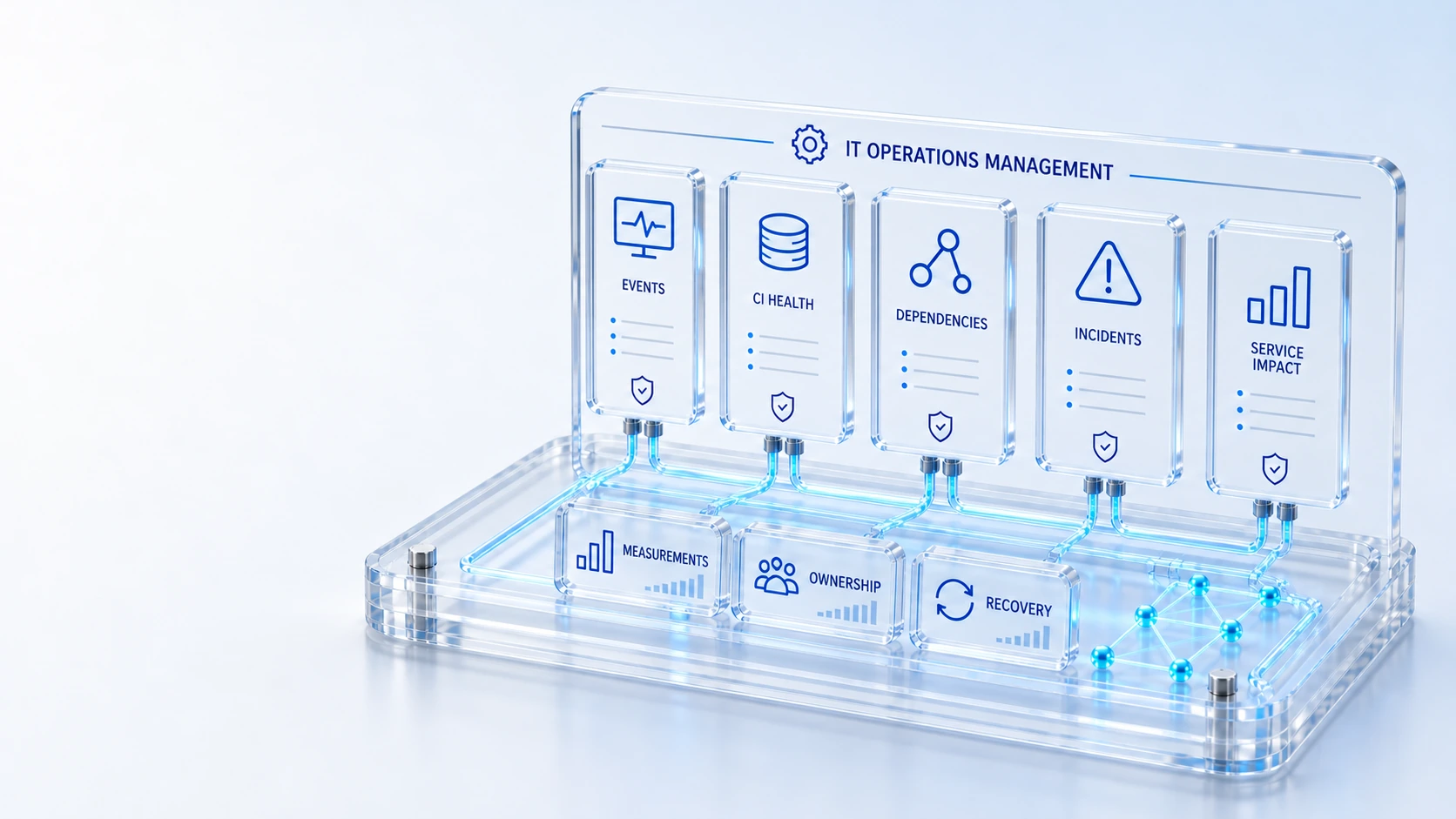
EventsBring recorded monitoring signals into an operating workspace.
AlertsReview severity, ownership, acknowledgment and alert state.
CI HealthDistinguish measured health from missing measurements.
DependenciesConnect technical investigation with saved infrastructure and service relationships.
SignalContext
Connect event operations, CI health, recorded dependencies and technical recovery.
Bring recorded monitoring signals into an operating workspace.
Review severity, ownership, acknowledgment and alert state.
Distinguish measured health from missing measurements.
Connect technical investigation with saved infrastructure and service relationships.
Signal → Context → Recovery
Explore the details below, then bring your workflow, source data and questions to a guided conversation.
Built into the platform
Bring recorded monitoring signals into an operating workspace.
Review severity, ownership, acknowledgment and alert state.
Distinguish measured health from missing measurements.
Connect technical investigation with saved infrastructure and service relationships.
Open the technical recovery record associated with operational context.
Inspect recorded signal, work and evidence history.
Actual product view
See the running demo environment. Features and records are subject to your role, configuration and integrations.
Connected by design
Service records, configuration items, people, locations and evidence share the same operational foundation. Move from investigation to the related asset, service or customer workflow with clear ownership.
Explore the platform architectureImplementation context
Features depend on enabled modules, configured roles, source data and supported integrations. Agree your implementation scope and acceptance criteria during discovery.
Who this is for
Monitoring integrations alone do not establish an operating model. Teams need an explicit relationship between event state, CI health, service dependencies and the technical incident so recorded signals can be interpreted with accountable recovery ownership.
Illustrative walkthrough
A fictional operations architect designs the handoff from an infrastructure alert to incident response. The walkthrough checks severity and acknowledgment, a known CI relationship and a deliberately unmeasured configuration item to clarify the foundation’s coverage limits.
Inspect the recorded event and alert fields needed for severity, state, ownership and acknowledgment, then identify the supported source that provides those observations. Bring recorded monitoring signals into an operating workspace.
Review measured CI health and saved service dependencies, making the difference between a healthy observation and a missing measurement visible to the response team. Distinguish measured health from missing measurements.
Open or follow the incident associated with the operational context and inspect the recorded signal, work and evidence history used by the responsible responders. Open the technical recovery record associated with operational context.
Demonstrate one signal-to-incident chain with its supporting CI and relationship records, then explain what the team can and cannot infer when health coverage or dependencies are missing. Use demonstration records and preserve the applicable reporting scope.
Explore the platform
Open a workspace for a closer look.
Prepare the evaluation
These are evaluation criteria, not promised outcomes. Agree the baseline, scope, source coverage and acceptance method with the responsible owners before drawing conclusions.
Questions for this topic
An alert can be reviewed on its own, but the foundation connects it with configuration and dependency context so the team can evaluate the service investigation more meaningfully.
No. Missing health measurements remain distinguishable from observed healthy state, and evaluators should inspect the available source coverage before interpreting an operational overview.
The linked technical incident and configured assignment process establish accountable response; the existence of a monitoring signal alone does not demonstrate that a recovery team has accepted the work.
Your next operating chapter
Bring one workflow, one service challenge or one part of your estate. We’ll show you where Qintorava fits.