IT and OT Classification
Classify equipment by functional role.
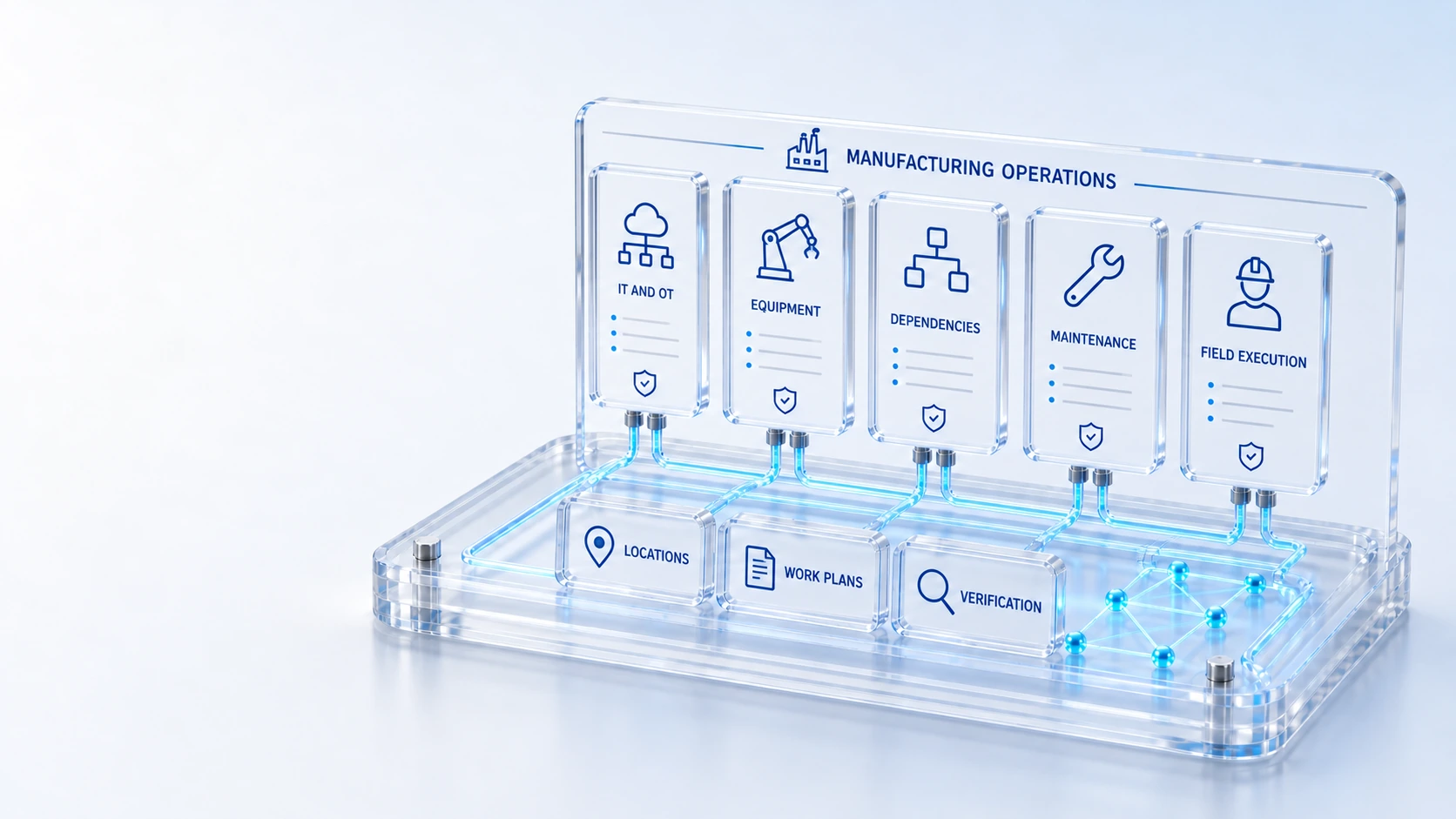
IT and OT ClassificationClassify equipment by functional role.
Recorded DependenciesTrace equipment and service relationships.
Maintenance ContextConnect lifecycle and governed work.
Qualified ExecutionCoordinate plans, checklists and verification.
ContextWork
Classify equipment by functional role, trace recorded dependencies and coordinate governed maintenance and field execution.
Classify equipment by functional role.
Trace equipment and service relationships.
Connect lifecycle and governed work.
Coordinate plans, checklists and verification.
Context → Work → Evidence
Use cases describe technology and service operations. Requirements and implementation scope are reviewed during discovery.
Built into the platform
Relate campus, site, building, floor, room and rack.
Distinguish compute, network, power, cooling and shared equipment.
Maintain typed classes and canonical configuration records.
Traverse recorded relationships and location ancestry.
Check skills, expiry, coverage, workload and resource absence.
Use published plans, dependencies and required checklists.
Actual product view
See the running demo environment. Features and records are subject to your role, configuration and integrations.
Connected capabilities
Connect facilities, customer equipment, IT/OT CIs, capacity, qualified work and service impact in a datacenter operating workspace.
Explore 02 / infrastructureConnect typed CIs, dependencies, service portfolios, services and offerings to hardware, software and customer operations.
Explore 03 / customerCoordinate qualified dispatch, work orders, appointments, recurring schedules and verified completion with cases and incidents.
ExploreImplementation context
Industry examples illustrate technology and service operations use cases, not industry certification or regulatory compliance. Scope, integrations, access and service commitments are agreed during discovery.
Who this is for
Manufacturing technology work crosses equipment locations, IT and OT classifications, service dependencies and maintenance responsibilities. Disconnected records make it harder to understand the operating context before planned work, while plant safety, industrial control and production decisions must remain with the organization’s authorized specialist systems and teams.
Illustrative walkthrough
An illustrative manufacturer evaluates technology service work on equipment associated with a production-supporting environment. The team reviews its recorded functional classification, physical location and dependencies, then coordinates qualified work and evidence without treating the platform as a controller of the production process.
Identify the relevant configuration item, location and IT or OT classification. Review the recorded relationships and accountable service owner before defining the work boundary. Distinguish evidence available in the platform from current plant conditions that require confirmation by the organization’s authorized engineering and operations personnel.
Bring the equipment and dependency context into the appropriate maintenance, change or qualified field workflow. Review the work plan and participating roles. Keep industrial control, safety isolation and production authorization outside any implied permission created by a service record or assignment in the enterprise platform.
Inspect execution and handback evidence alongside the recorded equipment relationships. Identify missing context or follow-up work with the responsible owners. Evaluate whether the workflow preserves a clear operational history without interpreting a completed technology task as proof that production safety, equipment condition or process readiness has been independently established.
Inspect IT/OT classification, physical and service relationships, qualified work context and review evidence. These support technology maintenance coordination, but do not replace PLC, SCADA, industrial safety systems, production controls or the specialist procedures governing work in a manufacturing environment.
Explore the platform
Open a workspace for a closer look.
Prepare the evaluation
These are evaluation criteria, not promised outcomes. Agree the baseline, scope, source coverage and acceptance method with the responsible owners before drawing conclusions.
Questions for this topic
This example describes enterprise technology records, dependencies and governed service work. It does not establish PLC, SCADA or production-control functionality. Keep control-system operation and industrial safety responsibilities with the authorized specialist systems and personnel, and confirm the platform’s intended boundary explicitly during discovery.
The reviewed platform includes IT and OT classification with configuration, physical and service relationships. Evaluate representative records and the responsibilities for maintaining them. A shared model can support coordination, but it does not remove the distinct engineering, access and safety requirements that apply to different equipment classes.
No. Field execution evidence is one part of the operational review. Production readiness and safety depend on the organization’s engineering checks, local procedures and authorized acceptance. Inspect how the work record supports that process without allowing its status to replace the specialist decisions required before production resumes.
Your next operating chapter
Bring one workflow, one service challenge or one part of your estate. We’ll show you where Qintorava fits.