Network and Services
Connect configuration and service relationships.
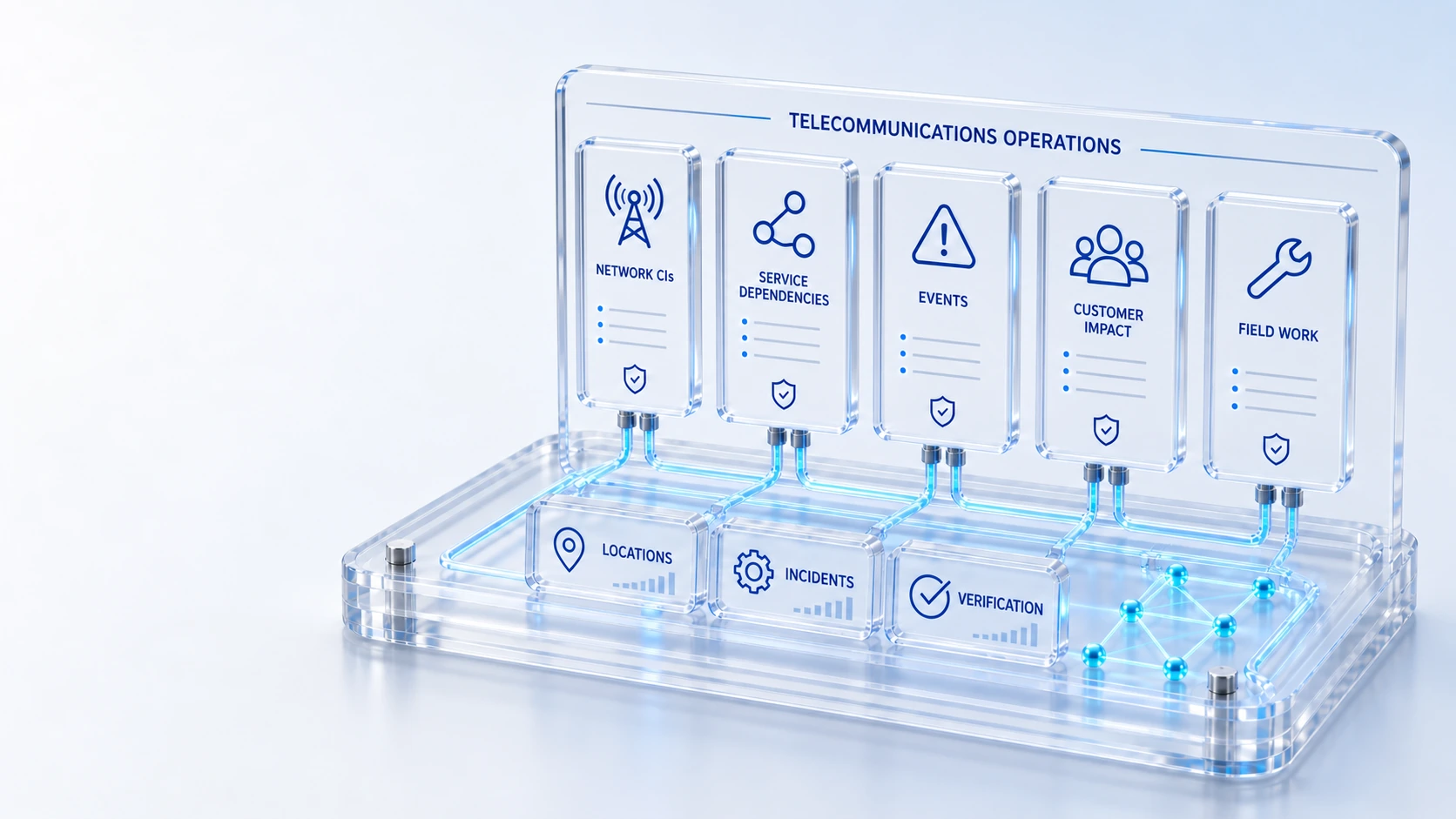
Network and ServicesConnect configuration and service relationships.
Operational SignalsBring event and alert ownership into investigation.
Customer ImpactRelate cases to technical recovery.
Qualified Field WorkCoordinate location-aware execution and handback.
ContextWork
Connect recorded network and service dependencies, operational events, customer impact and qualified field work.
Connect configuration and service relationships.
Bring event and alert ownership into investigation.
Relate cases to technical recovery.
Coordinate location-aware execution and handback.
Context → Work → Evidence
Use cases describe technology and service operations. Requirements and implementation scope are reviewed during discovery.
Built into the platform
Maintain typed classes and canonical configuration records.
Traverse recorded relationships and location ancestry.
Review operational events in a focused surface.
Track severity, acknowledgment and ownership.
Check skills, expiry, coverage, workload and resource absence.
Use published plans, dependencies and required checklists.
Actual product view
See the running demo environment. Features and records are subject to your role, configuration and integrations.
Connected capabilities
Connect typed CIs, dependencies, service portfolios, services and offerings to hardware, software and customer operations.
Explore 02 / infrastructureInvestigate events and alerts with affected CIs, ownership and linked incident evidence.
Explore 03 / customerCoordinate qualified dispatch, work orders, appointments, recurring schedules and verified completion with cases and incidents.
ExploreImplementation context
Industry examples illustrate technology and service operations use cases, not industry certification or regulatory compliance. Scope, integrations, access and service commitments are agreed during discovery.
Who this is for
Telecommunications service work can cross operational events, recorded network dependencies, customer context and site visits. Teams need to connect the signal to an accountable investigation and qualified field response while avoiding assumptions that a relationship model or event record provides complete network control or verified customer impact.
Illustrative walkthrough
In this illustrative scenario, a telecommunications technology team reviews an event associated with a recorded network configuration item. It inspects service relationships, relates technical response and coordinates a qualified visit where required, then reviews execution evidence with the accountable service owner before handback.
Review the event or alert, associated configuration item and available dependency information. Distinguish observed technical evidence from suspected customer impact. Confirm source coverage and service ownership before treating the relationship model as a complete representation of the network or assuming every related signal describes the same interruption.
Relate the signal to the appropriate incident and inspect the qualified location coverage and work plan if on-site work is required. Preserve network engineering, site access and safety responsibilities. An operational event or dispatch assignment should not be interpreted as authorization for unrestricted network configuration or equipment operation.
Inspect technical status, recorded execution and verification evidence with the relevant service owner. Keep unresolved network or customer questions visible for follow-up. Use the evaluation to understand the connected operating journey without equating task completion with complete network restoration, guaranteed coverage or confirmation that every customer impact has been resolved.
Inspect event ownership, recorded network and service relationships, incident links and qualified field evidence. These support telecommunications technology service coordination; they do not establish radio orchestration, spectrum management, network control capability, universal topology coverage or guaranteed service restoration.
Explore the platform
Open a workspace for a closer look.
Prepare the evaluation
These are evaluation criteria, not promised outcomes. Agree the baseline, scope, source coverage and acceptance method with the responsible owners before drawing conclusions.
Questions for this topic
This example addresses enterprise technology records, operational signals, incidents and qualified field work. It does not establish spectrum management, radio orchestration or unrestricted network control. Confirm the supported data sources, integrations and intended operating boundary separately with the relevant engineering and service owners during discovery.
No. It reflects recorded relationships within the available source coverage and configuration model. Evaluate representative network and service records, ownership and data-quality gaps before relying on the view. Missing or outdated relationships should remain explicit rather than being interpreted as proof that no dependency exists.
The responsible team should interpret the event, affected configuration context and technical investigation before choosing the next path. If on-site work is appropriate, review qualification, coverage and work planning. The evaluation should preserve that decision responsibility rather than assume every alert automatically warrants qualified field dispatch.
Your next operating chapter
Bring one workflow, one service challenge or one part of your estate. We’ll show you where Qintorava fits.